

Industry-specific digital platforms: Smart growth in 2026
Sponsored content. This article was supplied by a third party and Business Money has been paid to publish it.
Tailored marketing and sales platforms for niche industries
Understanding the rise of industry-specific digital platforms
The journey to digital transformation has seen most organizations adopting a “cloud-first” strategy. Indeed, by 2025, an estimated 85% of businesses expect to operate primarily in the cloud. However, relying solely on generic cloud platforms often leaves a critical gap. These broad solutions frequently fall short of addressing the unique, highly specialized operational, regulatory, and workflow demands of individual industries. As of 2023, fewer than 15% of businesses had adopted truly industry-specific digital platforms, highlighting a significant, unmet need.
Now, in August 2026, this landscape is rapidly changing. Gartner predicts that by 2027, over 70% of businesses will be utilizing industry cloud platforms. This rapid growth signals a pivotal shift in how organizations leverage technology. Industry-specific digital platforms are becoming indispensable. They are designed from the ground up to solve the “last mile” problems of digitalization, offering tailored solutions that generic platforms simply cannot provide.
These specialized platforms go beyond basic infrastructure. They deliver deep domain expertise, pre-configured compliance, and streamlined workflows directly relevant to a particular sector. They represent a strategic leap forward, enabling businesses to unlock new levels of efficiency, innovation, and profitability. For example, an end-to-end digital platform built for manufacturing can seamlessly integrate design, production, and supply chain processes, directly addressing industry-specific challenges.
In this extensive guide, we will explore industry-specific digital platforms. We will examine how they fundamentally differ from general cloud offerings and the strategic advantages they provide. Join us as we delve into their role in driving innovation, ensuring regulatory compliance, promoting sustainability, and overcoming complex integration hurdles. We aim to provide a clear roadmap for organizations looking to thrive in a specialized digital future.
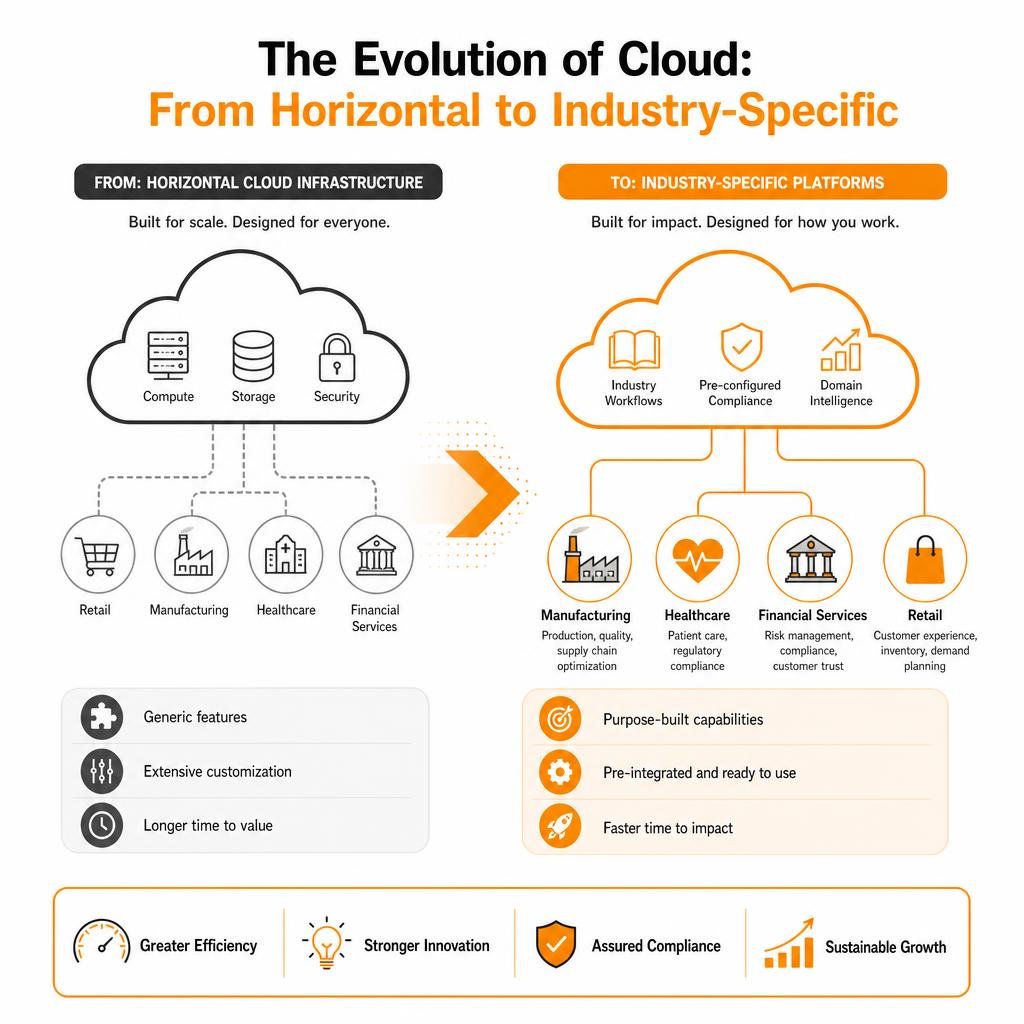
Industry-specific digital platforms, often referred to as vertical cloud platforms or sector-specific clouds, are sophisticated digital ecosystems meticulously crafted to serve the distinct operational, regulatory, and workflow requirements of a particular industry. Unlike their general-purpose cloud counterparts, which offer broad infrastructure and services applicable across many sectors, industry-specific platforms embed deep domain knowledge, pre-configured compliance frameworks, and specialized tools directly into their architecture. This allows them to address the nuanced challenges that generic solutions frequently overlook, providing a more precise and effective digital transformation path.
The growing adoption of these platforms is driven by a critical realization: a “one-size-fits-all” approach to digital technology is increasingly inadequate. While generic cloud platforms offer scalability and cost efficiency, they often necessitate extensive customization and integration efforts to meet industry-specific needs. This can lead to increased costs, slower deployment, and a higher risk of errors. Industry-specific platforms, conversely, arrive pre-optimized, significantly reducing the burden on in-house IT teams and accelerating time-to-value. They promise not just technological advancement, but a fundamental shift in how businesses operate within their unique market landscapes, fostering greater efficiency, innovation, and competitive resilience.
Feature Horizontal Cloud Software (e.g., AWS, Azure, Google Cloud) Vertical Industry Platforms (e.g., Healthcare Cloud, Manufacturing Cloud) Primary Focus General-purpose infrastructure, broad services Deep domain expertise, industry-specific workflows Target Audience All industries, broad use cases Specific industry sectors (e.g., BFSI, Healthcare, Manufacturing) Compliance & Regulation Generic tools, customer responsible for configuration Pre-configured, embedded regulatory frameworks (e.g., HIPAA, GDPR) Data Models Flexible, customer-defined Industry-standardized, specialized data models Integration Requires significant custom development Built-in integrations for common industry systems Time-to-Value Longer, due to customization Shorter, due to pre-built features and templates Cost Structure Pay-as-you-go for infrastructure, high customization costs Subscription-based, lower customization/maintenance costs Innovation Broad, general-purpose Domain-specific, embedded analytics and AI Vendor Lock-in Risk Can be high if heavily customized Managed through open APIs, data portability, and modularity Operational Efficiency Achieved through custom development Inherently optimized for industry-specific processes Architectural Distinctions from Generic Cloud Solutions
The fundamental difference between industry-specific digital platforms and general-purpose cloud platforms lies in their architectural philosophy. Generic cloud solutions operate on a “pipeline” model, optimizing internal, linear value chains to produce and deliver goods or services. They provide the raw computing power, storage, and networking, leaving the complex task of tailoring these resources to specific business processes to the end-user. This often entails extensive custom development, integration of disparate systems, and ongoing maintenance, creating significant “digital debt.”
In contrast, industry-specific platforms embody a “network” business model. They are designed as modular digital architectures that optimize multi-sided external interactions, generating scalable network effects through specialized infrastructure. This means they come with pre-built data models, specialized services, and tools that inherently understand the nuances of a particular sector. For instance, a healthcare platform will have native support for Electronic Health Records (EHR) standards, patient engagement workflows, and HIPAA compliance, rather than requiring these to be built from scratch atop a generic cloud.
Furthermore, these platforms often feature multi-tenant cloud environments that facilitate zero-migration deployment for many of their core functionalities. They are built with composable infrastructure principles, allowing businesses to select and integrate specific modules or services that align with their exact needs, rather than being forced into a monolithic solution. This reduces custom development overhead and allows for rapid deployment, as the platform is already configured with the necessary regulatory compliance and domain-specific logic. The result is a system that is not only more efficient but also more agile, capable of evolving with industry standards and emerging technologies.
Strategic drivers fueling sector-specific adoption
The shift towards industry-specific digital platforms is not merely a technological trend but a strategic imperative driven by several key factors. Firstly, stringent regulatory mandates and compliance requirements, particularly in sectors like healthcare (HIPAA), finance (Sarbanes-Oxley), and energy, make generic platforms a risky and costly proposition. Industry-specific platforms embed these compliance standards directly, significantly reducing the burden of in-house IT and custom software maintenance. This pre-configured compliance acts as a powerful de-risking factor, ensuring businesses can operate within legal frameworks from day one.
Secondly, the demand for enhanced workflow automation and deep domain intelligence is pushing organizations towards specialized solutions. Generic platforms often require businesses to adapt their processes to the software, whereas industry-specific platforms are built around existing, optimized workflows. This leads to higher operational efficiency, reduced manual errors, and faster execution of complex tasks. The embedded domain knowledge allows for more accurate analytics, predictive insights, and automated decision-making tailored to the unique challenges of the sector.
Moreover, the desire for faster time-to-value and the need to address accumulated legacy debt play crucial roles. Customizing generic cloud solutions can be a lengthy and expensive process, delaying the realization of benefits. Industry-specific platforms, with their pre-built functionalities, offer a quicker path to digital maturity. They are also designed to integrate more seamlessly with existing bespoke business logic and legacy systems, minimizing disruption while modernizing operations. This strategic advantage translates into better customer acquisition capabilities, as specialized platforms can deliver highly personalized experiences, and ultimately, improved margin optimization through streamlined operations and reduced overheads. The ability to innovate rapidly within a specific market, rather than being constrained by generic tools, provides a significant competitive edge.
Core architectural foundations: Balancing generativity, APIs, and governance
A critical aspect of successful industry-specific digital platforms is their ability to delicately balance generativity—the capacity for open innovation and third-party contributions—with robust control over governance, security, and data integrity. This tension is managed through carefully designed architectural foundations, particularly around digital interfaces and ecosystem curation. Platforms thrive on external innovation, yet they must also safeguard proprietary data, ensure compliance, and maintain a consistent user experience.

This balancing act is crucial for fostering a vibrant ecosystem without compromising the platform’s core values or regulatory obligations. It involves establishing clear rules of engagement, implementing advanced security protocols, and providing the necessary tools for external developers to innovate responsibly.
Managing boundary resources and complementor ecosystems
Digital interfaces, particularly APIs (Application Programming Interfaces) and SDKs (Software Development Kits), act as crucial “boundary resources” that define the interaction points between the platform’s core and its external ecosystem of third-party complementors. These resources are instrumental in enabling open innovation and value co-creation, allowing developers to build new applications, services, and integrations that extend the platform’s functionality. For example, in a financial services platform, APIs might allow fintech startups to integrate new payment solutions or specialized analytical tools, enriching the platform’s offering without the platform owner having to develop everything internally.
Effective API governance is paramount to this process. It involves setting clear standards for API usage, documentation, and versioning to ensure stability and compatibility. Platforms must decide on the degree of platform openness, determining which data and functionalities are exposed to external parties. Too much openness can lead to fragmentation, security vulnerabilities, or loss of control, while too little can stifle innovation. This requires careful consideration of platform boundaries and how they evolve over time.
Additionally, strategies for interface monetization can play a role, where access to premium APIs or data streams is offered on a tiered basis. This not only generates revenue but also incentivizes high-quality development and ensures that complementors are aligned with the platform’s long-term vision. The goal is to cultivate developer trust and foster a collaborative environment where external contributions enhance the platform’s value proposition while adhering to its core principles and security requirements. This dynamic interplay ensures that the platform remains adaptable, innovative, and secure.
Regulatory compliance and sectoral data sovereignty
For industry-specific digital platforms, navigating the complex landscape of regulatory compliance and ensuring data sovereignty is not an afterthought but a foundational design principle. Unlike generic platforms, which offer basic security, vertical platforms must embed specific legal and ethical frameworks directly into their core architecture.
In healthcare, for instance, HIPAA compliance is non-negotiable. Platforms must ensure the secure handling of Protected Health Information (PHI) through strict access controls, encryption, and audit trails. In financial services, platforms must adhere to regulations like Sarbanes-Oxley (SOX) for financial reporting and numerous anti-money laundering (AML) directives, requiring robust transaction monitoring, fraud detection, and immutable record-keeping. Similarly, the GDPR mandates in Europe dictate strict rules for data privacy and consumer consent, impacting how personal data is collected, stored, and processed across all sectors.
The challenge extends to cross-border data transfers, where different national laws on data residency and privacy can create significant hurdles. Industry-specific platforms often implement sophisticated data governance models that allow for localized data storage and processing, ensuring that data remains within specified geographical boundaries to comply with local laws. This also addresses concerns around financial risk and healthcare privacy, where data breaches can have catastrophic consequences.
Emerging regulations, such as those related to environmental disclosures (e.g., CSRD reporting in Europe) and product sustainability (e.g., ESPR for digital product passports), further underscore the need for platforms that can capture, verify, and report on complex data streams. Immutable audit trails, often leveraging blockchain technology, become critical for demonstrating compliance and transparency. By embedding these regulatory requirements from inception, industry-specific platforms provide a secure and legally sound environment, allowing businesses to focus on their core operations without constant fear of non-compliance.
Lifecycle strategy, network dynamics, and economic models
The journey of an industry-specific digital platform from conception to maturity involves intricate strategic decisions concerning its scope, the participants it attracts, and its interfaces. These choices are profoundly influenced by network effects and shape the platform’s economic viability and long-term sustainability. Understanding these dynamics is key to orchestrating growth and value capture within a specialized ecosystem.
Orchestrating network effects in industry-specific digital platforms
Network effects are the lifeblood of any successful digital platform, and in industry-specific contexts, their orchestration is particularly nuanced. These effects occur when the value of a product or service increases with the number of users. In vertical platforms, we observe both direct network value, where the value to a user increases as more users of the same type join (e.g., more doctors on a telehealth platform), and cross-side effects, where the value to one type of user increases as more users of a different type join (e.g., more patients attracting more doctors, and vice-versa).
Achieving critical mass is the initial hurdle for any platform. This involves attracting enough participants on all sides to make the platform valuable to new entrants. For industry-specific platforms, this often means targeting a specific niche with high pain points, where the value proposition is immediately clear. Factors like multi-homing friction (the ease or difficulty of users participating in multiple platforms simultaneously) can impact how quickly a platform achieves dominance. If users can easily switch or use multiple platforms, competition remains high.
Platforms must cultivate niche liquidity, ensuring there are enough buyers and sellers (or producers and consumers) to facilitate frequent and meaningful transactions. This drives transaction volume and reinforces the platform’s utility. Building bilateral trust and mitigating counterparty risk are also crucial, especially in B2B industry platforms where transactions can be high-value and complex. Mechanisms like escrow services, verified profiles, and transparent rating systems help build this trust, reducing perceived risk and encouraging participation. By strategically managing these network dynamics, industry-specific platforms can create powerful self-reinforcing loops that drive exponential growth and solidify their market position.
Lifecycle evolution: Managing scope, sides, and envelopment
Digital platforms, particularly those tailored to specific industries, undergo distinct evolutionary phases, each requiring a recalibration of strategic decisions regarding firm scope, platform sides, and interfaces. During the launch phase, the primary objective is often rapid user acquisition and achieving critical mass. Here, platforms tend to maintain an asset-light model, focusing on aggregating data and facilitating interactions rather than owning extensive physical assets or employing large workforces. Interfaces are typically more open, and the platform actively subsidizes one side (e.g., offering free tools to developers or discounted access to initial users) to attract participants and stimulate network effects. This approach prioritizes growth over immediate profit maximization.
As a platform enters maturity, its strategy often shifts. The platform may engage in maturity recalibration, expanding its firm scope through vertical integration or horizontal bundling. This could involve acquiring complementary businesses, offering proprietary services that were previously provided by third parties, or integrating new functionalities directly into the core platform. This expansion can lead to platform envelopment, where an established platform enters adjacent markets by bundling functionality and leveraging existing user relationships, potentially displacing smaller, specialized platforms.
The curation of platform sides also becomes more stringent in maturity. To maintain quality and capture value, platforms might introduce stricter vetting processes for participants, implement tiered membership models, or even restrict access to certain functionalities. Interfaces, while still critical for innovation, may become more controlled or monetized, balancing the need for external contributions with the platform’s desire to capture a larger share of the value created. The goal is to evolve from a pure facilitator to a more integrated ecosystem manager, creating captive ecosystems that are harder for users to leave, thus solidifying market leadership and ensuring long-term profitability.
Operational impact: Integrating niche workflows, automation, and sustainability
The true power of industry-specific digital platforms is realized in their operational impact, particularly in their ability to seamlessly integrate with existing niche workflows, leverage automation for efficiency, and promote sustainability across multiple dimensions. These platforms are designed to address the unique operational challenges of a sector, transforming how businesses operate day-to-day.

This holistic approach ensures that digital transformation is not just about technology adoption, but about fundamental improvements in efficiency, compliance, and responsible business practices.
Overcoming integration friction and legacy system constraints
One of the most significant challenges for any enterprise digital transformation, especially within established industries, is integration friction with existing legacy systems. Many businesses rely on decades-old ERPs, CRMs, and specialized operational software that are deeply embedded in their workflows. Industry-specific digital platforms are designed with this reality in mind, offering sophisticated mechanisms to bridge the gap between old and new.
Rather than demanding a complete overhaul, these platforms prioritize seamless legacy synchronization. This involves supporting both batch and real-time data exchange, utilizing robust API connectors, and employing advanced middleware orchestration to ensure data flows accurately and consistently between systems. The goal is to minimize technical debt and avoid the pitfalls of vendor lock-in by providing flexible integration pathways. For example, a manufacturing platform might integrate directly with existing CAD/CAM software and shop-floor control systems, ensuring that production data is instantly reflected in inventory and order management.
Effective data ingestion pipelines are crucial, allowing platforms to pull relevant information from diverse sources, standardize it, and make it actionable. This also extends to ERP mapping, where the platform intelligently translates data structures between the legacy ERP and its own domain-specific models. By offering modular architectures and open standards, industry-specific platforms empower businesses to modernize incrementally, preserving valuable past IT investments while gradually transitioning to more agile, cloud-native environments. This strategic approach mitigates risk and ensures operational continuity during the digital transition.
Scaling low-code tools in industry-specific digital platforms
The democratization of application development is a hallmark of modern digital platforms, and low-code and no-code tools play a pivotal role in making industry-specific platforms more accessible to non-technical users. These tools empower “citizen developers”—business users with deep domain knowledge but limited coding expertise—to create, customize, and automate workflows directly within the platform environment.
Low-code interfaces, characterized by drag-and-drop automation, visual modelers, and intuitive rule builders, significantly accelerate the development and deployment of new applications and processes. This capability is particularly valuable in niche industries where bespoke requirements frequently emerge, and the speed of response can be a competitive differentiator. For instance, a healthcare administrator might use low-code tools to quickly build a custom patient intake form that integrates with the EHR, or a financial analyst could automate a compliance reporting workflow without needing to engage IT developers.
This non-technical enablement fosters greater operational autonomy and allows businesses to adapt rapidly to changing market conditions or regulatory requirements. It reduces reliance on scarce and expensive professional developers for every customization, leading to increased deployment velocity. Furthermore, by empowering those closest to the business problem to create solutions, industry-specific platforms can continuously optimize process orchestration and drive efficiency from the ground up. This shift not only reduces costs but also cultivates a culture of continuous improvement and innovation, ensuring the platform remains highly relevant and adaptable to its specific industry’s evolving needs. For businesses looking to optimize their digital outreach and operational efficiency, leveraging such integrated platforms can significantly enhance their performance-based marketing strategies.
Frequently asked questions about industry-specific digital platforms
How do industry-specific platforms mitigate vendor lock-in?
Industry-specific platforms are designed with several strategies to mitigate the risk of vendor lock-in, a common concern with specialized solutions. Firstly, they often adopt open standards and prioritize API-first design, ensuring that data and functionalities can be accessed and integrated with other systems. This interoperability allows businesses to connect the platform with their existing technology stack and potentially switch components if needed. Secondly, their modular architectures and composable ecosystems mean that businesses can select specific functionalities or services rather than being tied to an entire monolithic suite. This flexibility enables easier replacement of individual modules. Thirdly, a strong emphasis on data portability ensures that businesses can extract their data in standard formats, preventing proprietary data silos. Finally, many providers offer hybrid deployment options, allowing organizations to run certain components on-premises or in other cloud environments, providing greater control and reducing dependence on a single vendor’s infrastructure.
What role does domain-specific AI play in vertical SaaS?
Domain-specific AI is a cornerstone of vertical SaaS, elevating industry-specific platforms beyond mere automation tools to intelligent operational partners. Unlike generic AI, which offers broad capabilities, domain-specific AI is trained on vast datasets unique to a particular industry, enabling it to understand and process highly specialized information. For example, in manufacturing, AI can perform bill-of-materials extraction from complex engineering drawings, conduct predictive inventory analysis based on historical demand and supply chain signals, and even automate automated quoting processes by cross-referencing technical specifications with pricing data. In finance, it powers automated credit scoring and fraud detection, while in healthcare, it can analyze unstructured patient data for diagnostic support. This specialized intelligence allows platforms to offer highly accurate insights, automate complex tasks that require expert knowledge, and significantly reduce manual effort, transforming raw data into actionable intelligence for industry professionals.
How do vertical platforms balance open innovation with regulatory control?
Balancing open innovation with stringent regulatory control is a delicate act for vertical platforms, but it’s essential for fostering a dynamic ecosystem while ensuring compliance. They achieve this through a combination of strategic architectural and governance mechanisms. Boundary resources, such as well-defined APIs and SDKs, are designed to expose only necessary functionalities and data to third-party developers, while strict access controls and role-based permissions limit what external parties can do. Platforms often implement compliance sandboxes where developers can test their integrations against regulatory requirements before deployment. Automated audits and continuous monitoring ensure that all interactions and data flows adhere to industry-specific regulations. Furthermore, technologies like cryptographic verification and immutable audit trails provide transparency and accountability, allowing platforms to demonstrate compliance to regulators while still encouraging external contributions. This layered approach ensures that innovation occurs within a secure, governed, and compliant framework.
Conclusion
As we navigate the complexities of the digital age, the evolution from generic cloud solutions to industry-specific digital platforms represents a profound shift in how businesses achieve enterprise agility and competitive advantage. By focusing on the unique demands of individual sectors, these platforms provide tailored solutions that address “last-mile” challenges, streamline operations, and embed compliance directly into their architecture. From healthcare to manufacturing, finance to retail, the ability to leverage deep domain intelligence and specialized workflows is no longer a luxury but a necessity.
The strategic adoption of these platforms allows organizations to overcome legacy system constraints, foster vibrant complementor ecosystems through carefully managed APIs, and orchestrate powerful network effects. They empower citizen developers with low-code automation tools, driving efficiency and innovation from within, while simultaneously promoting sustainability across economic, environmental, and social dimensions. As the market continues its rapid growth, with projections indicating widespread adoption by 2027, the choice to embrace vertical specialization will define leaders in every industry.
Industry-specific digital platforms offer a clear strategic adoption roadmap for businesses seeking continuous modernization and sustained growth. They are not just technological upgrades; they are foundational shifts that enable organizations to thrive in highly specialized markets, ensuring they remain competitive and resilient in an ever-evolving digital landscape.