

Astros pitching rotation schedule: Master real-time updates
Sponsored content. This article was supplied by a third party and Business Money has been paid to publish it.
Staying informed with a digital news aggregator
How a digital news aggregator curates real-time content

Keeping track of every detail for your favorite sports team, especially their dynamic pitching staff, can be a challenge. As Houston Astros fans follow their team through the 2026 season, staying updated on the pitching rotation schedule is crucial for understanding strategy and anticipating game outcomes. We know how quickly lineups can change due to injuries, performance, or strategic adjustments.
Fortunately, modern digital news aggregators are designed to simplify this information stream. These platforms gather relevant news from countless sources, offering a streamlined way to get the specific updates you care about. We’ll show you how these powerful tools can curate real-time content and filter live information, ensuring you always have the latest insights into the Astros’ pitching plans. For a deeper dive into the specific dynamics, a reliable digital news aggregator can quickly bring you up to speed on the Houston Astros pitching rotation schedule and probable starters.

In today’s sports world, staying current with every development, particularly for a team like the Houston Astros with its complex pitching dynamics, requires more than just checking a single source. Digital news aggregators act as sophisticated information hubs, pulling in content from a vast array of online publications, official team announcements, and expert analyses. They achieve this through mechanisms like RSS feeds and API integrations, which allow them to constantly monitor and collect new articles, reports, and data as soon as they are published.
Imagine an aggregator operating as your personal Astros beat reporter, but with the ability to simultaneously read hundreds of sources. When news breaks about a pitcher’s injury status, a last-minute rotation change, or a performance adjustment, these platforms are designed to capture it. The core of their power lies in algorithmic filtering, which sifts through this deluge of information to identify content relevant to your interests. For Astros fans, this means automatically receiving updates on the starting rotation, bullpen usage, and player performance without having to manually visit dozens of websites. This real-time content syndication ensures that we are always equipped with the freshest insights, crucial for understanding a team currently holding a 33-40 record and sitting 4th in the AL West as of June 2026.
Content categorization in a digital news aggregator
The sheer volume of sports news generated daily necessitates robust categorization. Digital news aggregators employ advanced topic taxonomy and automated tagging to organize incoming information. This means that an article discussing Hunter Brown’s recent performance—perhaps his 3-5 record with a 3.71 ERA and 49 strikeouts in 2026—is not just seen as “sports news” but specifically tagged under “Houston Astros,” “pitching,” “Hunter Brown,” and “starting rotation.” This granular categorization is vital for fans tracking nuanced information. It allows the aggregator to identify and prioritize content related to specific players, such as Cristian Javier’s return from injury or the strategic role of depth options like Spencer Arrighetti and Kai-Wei Teng.
By leveraging these sophisticated systems, aggregators can create niche media feeds tailored precisely to our interests. Instead of sifting through general MLB news, we receive dynamic feeds focused exclusively on the Astros’ pitching staff. This ensures that every update, whether it’s about Lance McCullers Jr.’s rehab progress, Ronel Blanco’s status, or Mike Burrows’ struggles with command, is delivered directly to us, categorized and ready for consumption. This level of organization is what transforms a chaotic information stream into a coherent and highly relevant resource.
Filtering live information with a digital news aggregator
The ability to filter live information is where digital news aggregators truly shine for sports tracking. For Astros fans, this means setting up specific parameters to receive only the most critical updates. We can configure custom alerts for various scenarios: a notification when the probable pitchers for an upcoming series against, say, the Tigers, Guardians, or Royals are announced; an alert detailing injury updates for key players like Hunter Brown or Cristian Javier; or even a summary of how depth options such as Tatsuya Imai and Peter Lambert are being utilized in the short-term schedule.
These real-time updates are invaluable. For instance, knowing the projected starters for the June 15-17 Tigers series—Melton, Valdez, and Mize for the Astros (according to one source, though others list different probable pitchers for the Astros like Teng, Valdez, and Lambert)—or the Guardians series, allows us to anticipate matchups and understand managerial decisions. An aggregator can consolidate this information from multiple sources, presenting a clearer picture of the rotation order and how it incorporates returning pitchers. This proactive approach to information gathering helps us stay ahead, understanding not just who is pitching, but why they are pitching, especially during stretches of 10+ games in 10-13 days when managing a six-man rotation becomes paramount.
Key features to look for in modern aggregators

When selecting a digital news aggregator to keep tabs on the Astros’ pitching rotation, several key features elevate the user experience from merely functional to truly indispensable. Modern aggregators offer a suite of tools designed for efficiency and personalization. We look for platforms that provide robust personalization options, allowing us to fine-tune our news feed to the minutest detail. This includes the ability to prioritize specific teams, players, or even types of news, ensuring that updates on the Astros’ starting rotation always take precedence.
Offline reading capabilities are a significant advantage, enabling us to catch up on the latest pitching insights, injury reports, or strategic analyses even when internet access is limited. Cross-platform synchronization ensures a seamless experience, allowing us to start reading an article on a desktop and pick it up instantly on a mobile device, or vice-versa. Perhaps most critically for real-time sports updates are push notifications. These instant alerts can notify us the moment a probable pitcher is confirmed, a rotation change is announced, or a crucial injury update is released, ensuring we never miss a beat in the dynamic world of MLB pitching.
Customizable feed preferences
The true power of a digital news aggregator lies in its ability to cater to individual preferences. For dedicated Astros fans, customizable feed preferences mean we can meticulously curate our information stream. This involves precise topic filtering, allowing us to specify that we only want news related to “Houston Astros pitching rotation,” “Hunter Brown injury update,” or “Cristian Javier return timeline.” We can also engage in source curation, selecting our most trusted sports journalists, official team announcements, and reputable news outlets while filtering out less reliable sources.
Priority alerts are another crucial aspect, enabling us to designate certain types of news as “high priority.” For example, if we are closely following the adjustments being made for pitchers struggling with command or home runs, such as Mike Burrows (who has allowed 13 home runs and has an ERA of 5.40), we can set alerts to highlight any articles discussing his pitch sequencing changes or bullpen sessions. Similarly, tracking the progress of depth options like Spencer Arrighetti, Kai-Wei Teng, Tatsuya Imai, and Peter Lambert as they potentially fill short-term rotation spots becomes effortless. This level of control ensures that our news feed is not just comprehensive, but also highly relevant and tailored to our specific interests in the Astros’ pitching staff.
Integration of real-time sports and event schedules
For any avid sports fan, particularly those tracking the intricate details of an MLB pitching rotation, the integration of real-time sports and event schedules into a digital news aggregator is non-negotiable. This feature goes beyond simply listing game times; it actively pulls in probable pitchers, updates on last-minute changes, and even provides context for the matchups. For the Houston Astros, this means we can see the projected starting pitchers for an upcoming series—say, the June 15-17 series against the Detroit Tigers, or the June 19-20 series against the Guardians—alongside their recent performance statistics.
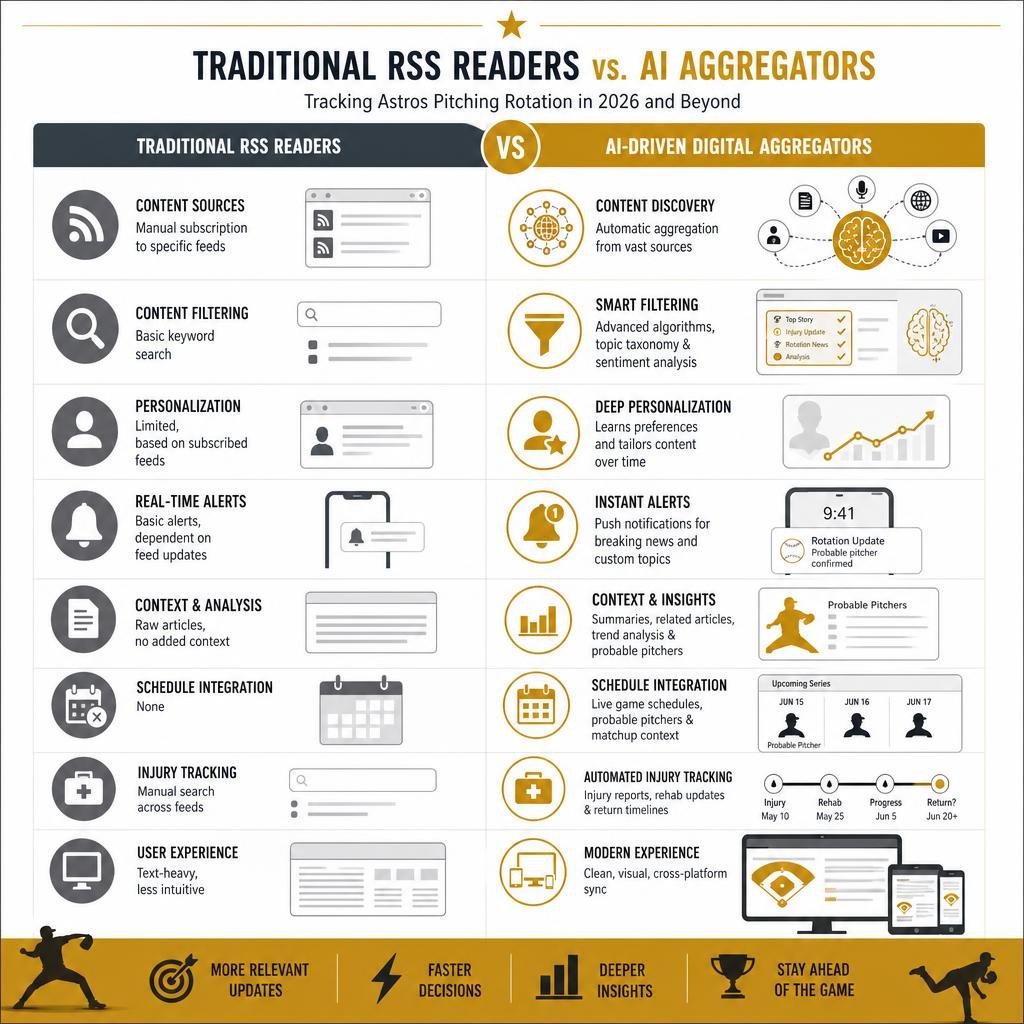
An aggregator can display the rotation order, explaining how returning pitchers like Hunter Brown and Cristian Javier are being incorporated, or how the team plans to manage a six-man rotation during demanding stretches of 10+ games in 10-13 days. It can highlight when key rehab assignments or returns are expected, and how they will impact the rotation’s composition. For instance, if Hunter Brown is slated to return to the majors during the June 15-17 series against the Tigers, or if Cristian Javier is not far behind, the aggregator would provide these critical updates, often with links to more detailed analyses. This contrasts sharply with traditional RSS readers, which might provide raw feeds but lack the intelligent processing and presentation of modern AI-driven aggregators.
Feature Traditional RSS Readers AI-Driven Digital Aggregators Content Source Manual subscription to specific feeds Automatic discovery & aggregation from vast sources Content Filtering Basic keyword search Advanced algorithmic filtering, topic taxonomy, sentiment analysis Personalization Limited, based on subscribed feeds Deep customization, learning user preferences over time Real-time Alerts Often basic, dependent on feed updates Instant push notifications for breaking news, custom topics Context & Analysis Raw articles, no added context Summaries, related articles, trend analysis, probable pitchers Schedule Integration None Direct integration of sports schedules, probable pitchers, stats User Interface Often text-heavy, less intuitive Modern, visually appealing, cross-platform sync Injury Tracking Manual search across feeds Automated tracking of player injuries, rehab updates
This integration is particularly useful when analyzing the probable pitchers listed for the next 7 days (June 15-21). An aggregator can present a clear, consolidated view of who is expected to pitch, such as Spencer Arrighetti, Kai-Wei Teng, Peter Lambert, Tatsuya Imai, and Mike Burrows, along with their relevant statistics (e.g., Teng’s 3-5 record, 3.71 ERA, 49 strikeouts). By providing this comprehensive, real-time overview, we can make informed decisions, whether it’s for fantasy sports or simply to better understand the Astros’ strategic approach to their season.
Managing complex information streams efficiently
The Houston Astros’ pitching staff is a complex ecosystem, especially in the 2026 season with its blend of established veterans, returning injured players, and promising depth options. As of August 2026, the team’s rotation includes 12 pitchers on the 40-man roster, with multiple key arms on the injured list (IL-60). This intricate scenario, coupled with a 33-40 record and 4th place standing in the AL West, makes efficient information management indispensable for any dedicated fan. Digital news aggregators are specifically designed to tackle such complex information streams, transforming a potential data overload into a clear, actionable overview.
These platforms excel at schedule tracking, seamlessly integrating game dates with probable pitcher assignments. This allows us to quickly identify who is slated to pitch in upcoming series against teams like the Tigers, Guardians, or Royals. Beyond simple scheduling, aggregators provide critical injury reports, offering the latest on players like Hunter Brown and Cristian Javier, who are returning from injuries, or Lance McCullers Jr. and Ronel Blanco, whose statuses significantly impact the rotation. We can track their rehab assignments and expected return dates, understanding how their re-entry will reshape the pitching staff.
Furthermore, aggregators assist in roster management by highlighting the roles of depth options. When the Astros face a demanding schedule, requiring them to manage a six-man rotation during stretches of 10+ games in 10-13 days, these tools can clarify how pitchers like Spencer Arrighetti, Kai-Wei Teng, Mike Burrows, Tatsuya Imai, and Peter Lambert are being utilized. For instance, if Mike Burrows is struggling with command or home runs (he has the highest ERA among qualified major-league starters, and has allowed 17 home runs, most in the AL), an aggregator can gather news on potential adjustments being made or whether his spot in the rotation is in jeopardy. By consolidating all this dynamic information, digital news aggregators empower us to understand the intricate strategies and challenges facing the Astros’ pitching staff, providing unparalleled insight into their ongoing season.
Frequently asked questions about news aggregation
How does a digital news aggregator gather articles from multiple sources?
Digital news aggregators employ sophisticated technology to gather articles from a vast array of online sources. Primarily, they utilize web feeds, most commonly RSS (Really Simple Syndication) feeds, which are standardized formats for syndicating content from websites. Publishers create these feeds, allowing aggregators to automatically detect and pull new articles as they are published. Beyond RSS, many aggregators also integrate directly with websites and content providers through APIs (Application Programming Interfaces). These APIs allow for a more direct and often richer exchange of data, ensuring that the aggregator receives the most up-to-date content, including text, images, and sometimes even multimedia. This continuous content syndication process ensures a comprehensive and real-time flow of information.
Can a digital news aggregator track specific topics like sports rotation schedules?
Absolutely. One of the core strengths of digital news aggregators is their ability to track highly specific topics, making them ideal for following sports rotation schedules. Users can set up keyword alerts for terms like “Astros pitching rotation,” “Hunter Brown probable pitcher,” or “Cristian Javier injury update.” The aggregator’s algorithms will then filter incoming content to identify and deliver only articles and updates containing these specified keywords. Many platforms also offer specialized feeds for sports, allowing users to subscribe directly to team-specific news or even individual player updates. This ensures that real-time schedules, team updates, and any changes to the pitching rotation are promptly delivered, keeping fans fully informed without sifting through irrelevant news.
Is using a digital news aggregator secure and private?
The security and privacy of using a digital news aggregator largely depend on the specific platform chosen. Reputable aggregators prioritize user data privacy and implement robust security protocols. They typically allow users to control their data, offering options for anonymous browsing or ensuring that personal preferences are not linked to identifiable information. While some aggregators might use anonymized data to improve their recommendation algorithms, they generally adhere to strict data protection regulations. We should always review the privacy policy of any aggregator we choose to use. Look for platforms that offer clear explanations of how they handle user data, provide options for tracking controls, and utilize secure connections (HTTPS) to protect information exchanged between our device and their servers.
Conclusion
In the dynamic landscape of professional sports, staying abreast of every development, especially concerning a team’s pitching rotation, can be a daunting task. For Houston Astros fans navigating the 2026 season, the constant flux of injuries, performance adjustments, and strategic decisions makes a reliable information source indispensable. Digital news aggregators offer a powerful solution, transforming a fragmented and overwhelming stream of data into a coherent and personalized news experience.
Through their sophisticated content synthesis capabilities, these platforms curate real-time updates from countless sources, categorize information with precision, and filter live data to deliver exactly what we need. From tracking probable pitchers for upcoming series to monitoring the rehab progress of key players like Hunter Brown and Cristian Javier, or understanding the strategic deployment of depth options, aggregators streamline our access to critical insights. They enhance our media efficiency, ensuring we receive push notifications for breaking news and can access detailed analyses on demand. By embracing the power of these tools, we can remain truly informed readers, benefiting from streamlined updates that deepen our understanding and appreciation of the Astros’ journey through the season.