

Vendor risk management solutions for 2026
Sponsored content. This article was supplied by a third party and Business Money has been paid to publish it.
Navigating corporate intelligence and third-party risk management
The strategic value of corporate intelligence and third-party risk management
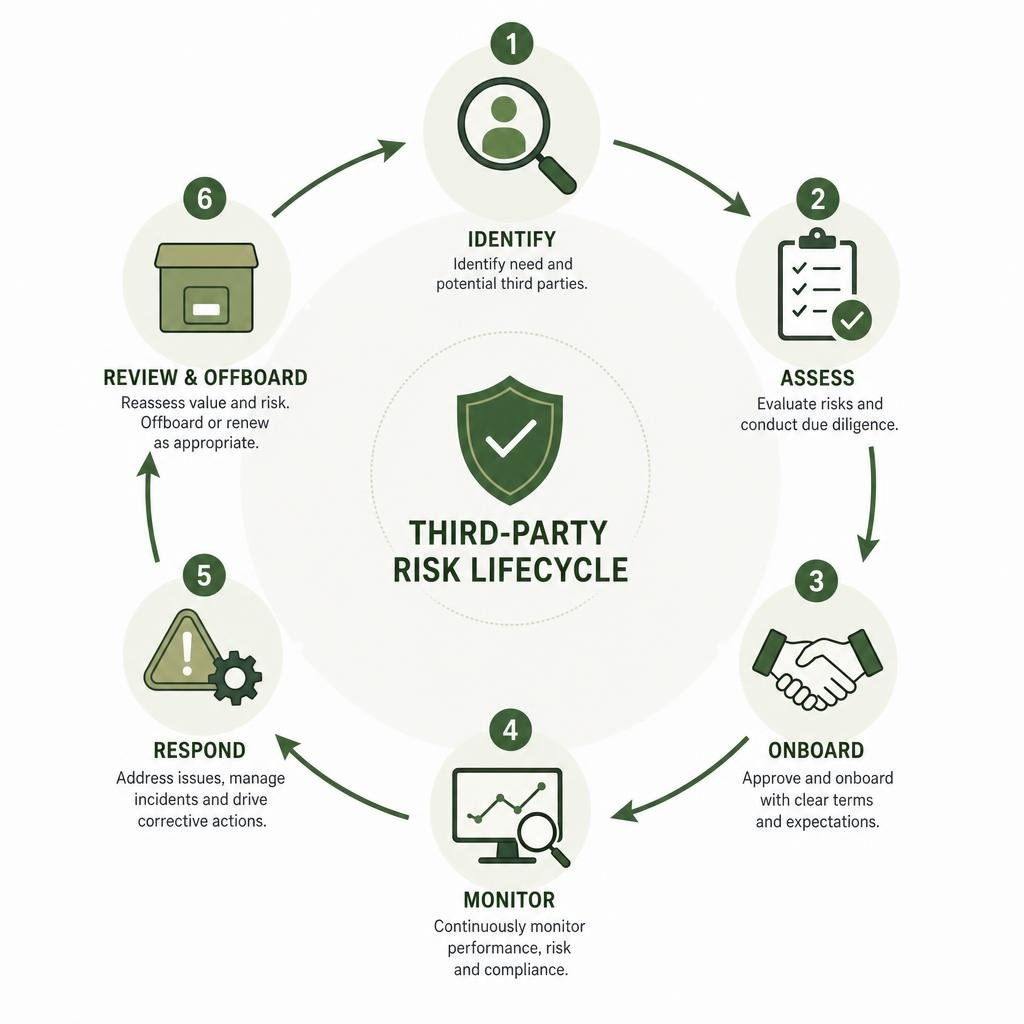
In today’s interconnected global economy, an organization’s operational resilience is inextricably linked to the health and stability of its vendor ecosystem. Relying on external partners for critical functions, from cloud hosting to supply chain logistics, introduces inherent and residual risks that, if unmanaged, can quickly erode competitive advantage. A robust Vendor Risk Management (VRM) program, underpinned by comprehensive corporate intelligence, is no longer just about compliance; it’s about strategic foresight and maintaining business continuity.
The strategic value of effective VRM lies in its ability to provide a unified view of risk exposure across all third-party relationships. This holistic perspective allows organizations to proactively identify potential vulnerabilities, make informed decisions about new partnerships, and ensure that existing vendors align with their risk appetite. By systematically evaluating and monitoring vendors, businesses can prevent costly disruptions, protect their brand reputation, and avoid significant financial penalties associated with regulatory breaches. Moreover, a well-managed vendor landscape can become a source of competitive advantage, enabling faster, more secure innovation and market responsiveness.
Integrating corporate intelligence and third-party risk management workflows
Effective VRM is built upon a foundation of thorough due diligence and continuous intelligence gathering. This isn’t merely a checkbox exercise; it requires a deep dive into a vendor’s background, operations, and financial health. Corporate intelligence plays a pivotal role here, moving beyond basic questionnaires to leverage external data sources for a more complete risk profile. This includes detailed background verification, sanctions screening against global watchlists, and comprehensive checks for politically exposed persons (PEPs) or adverse media mentions.
Integrating these corporate intelligence workflows directly into a TPRM platform ensures that due diligence is not a one-time event but an ongoing process. Automated tools can pull data from various external sources, cross-reference it with internal assessments, and flag potential concerns for further investigation. For organizations seeking specialized expertise in these complex investigations, external providers offering dedicated third-party risk management services can be invaluable. Such services provide in-depth analysis and verification, often delivering cost-certain reports with rapid turnaround, which is a deliberate contrast to the variable and often opaque fees associated with larger, more traditional incumbents. For instance, a comprehensive screenings report might start from around $1,595 and be delivered in approximately two working days, while a more extensive corporate intelligence report could start from $7,850 and be ready in about five working days. For enhanced due diligence and bespoke corporate due diligence, clients are typically directed to request a tailored quote, ensuring that the scope and cost are perfectly aligned with their specific needs. This approach offers transparency and predictability, crucial elements when navigating the intricate world of vendor risk.
Mitigating supply chain vulnerabilities through corporate data
The interconnectedness of modern supply chains means that an organization’s risk exposure extends far beyond its direct vendors, encompassing fourth-party risks—the vendors of its vendors. Understanding and mitigating these deeper vulnerabilities requires sophisticated corporate data analysis. This involves not only assessing the financial viability of direct partners but also scrutinizing their sub-contractors and critical suppliers. Tools that can perform in-depth PEP profiling and financial health checks across an extended supply chain are essential.
Open-source intelligence (OSINT) analysis and continuous adverse media monitoring are critical components of this strategy. By scanning news feeds, social media, and other public sources, organizations can detect early warning signs of financial distress, legal issues, or reputational damage that might impact a vendor. For example, an unexpected leadership change or a significant lawsuit against a fourth-party supplier could signal an impending disruption to your own operations. VRM solutions that integrate these external intelligence feeds provide a dynamic, real-time picture of potential supply chain vulnerabilities, allowing for proactive mitigation rather than reactive crisis management. This continuous vigilance helps organizations identify and address risks before they escalate, protecting both their operations and their bottom line.
Evaluating vendor risks across critical operational domains
Vendor relationships expose organizations to a multitude of risks, each with the potential for significant impact. Effective VRM solutions categorize and assess these risks across critical operational domains, providing a structured approach to understanding and mitigating potential threats. These domains typically include cyber, legal, reputational, and financial risks, each requiring specific assessment methodologies and monitoring strategies.
Cyber risk, perhaps the most prevalent and rapidly evolving threat, involves the potential for data breaches, system compromises, or service disruptions originating from a vendor’s IT infrastructure. Legal exposure can arise from non-compliance with regulations like GDPR or DORA, contractual disputes, or intellectual property infringements. Reputational damage can stem from a vendor’s unethical practices, security incidents, or public controversies that reflect poorly on your organization. Finally, financial instability within a vendor can lead to service interruptions, supply chain failures, or even bankruptcy, directly impacting your operations. A comprehensive VRM strategy must address all these facets to ensure robust protection.
Cyber and operational risk domains
The digital transformation has made cyber risk a paramount concern in vendor relationships. Vendors often have access to sensitive data, critical systems, or network infrastructure, making them potential entry points for cyberattacks. A major concern is “shadow IT,” where unauthorized applications or services are used by employees, often introducing unvetted third parties and creating blind spots in an organization’s security posture. VRM solutions must be capable of identifying and assessing these hidden risks.
When evaluating vendors, organizations need to scrutinize their cybersecurity posture, including their adherence to standards like SOC 2, their incident response capabilities, and their network security controls. Continuous monitoring is crucial here; a one-time assessment can quickly become outdated. Modern VRM platforms integrate with external security rating services and threat intelligence feeds to provide real-time insights into a vendor’s cyber health. For example, if a vendor experiences a data breach, the VRM solution should immediately flag this, allowing your organization to assess its own exposure and take mitigating actions. The ability to automatically pull findings from SOC 2 reports, DPAs, and other security documentation can significantly cut assessment time, freeing up security teams for more strategic tasks.
Regulatory and reputational risk domains
Beyond cyber threats, vendors can introduce substantial regulatory and reputational risks. Non-compliance with increasingly stringent global regulations carries severe penalties. For instance, the Foreign Corrupt Practices Act (FCPA) imposes strict anti-bribery measures, and organizations are held responsible for the actions of their third parties. Similarly, the Digital Operational Resilience Act (DORA) for financial services and the General Data Protection Regulation (GDPR) for data privacy mandate rigorous oversight of third-party service providers. Failure to ensure vendor compliance with these frameworks can result in hefty fines and legal repercussions.
Reputational risk is equally critical. A vendor’s ethical lapse, environmental violations, or poor labor practices can quickly tarnish an organization’s brand. VRM solutions address these risks by incorporating comprehensive risk scoring models that evaluate a vendor’s adherence to legal, ethical, and industry-specific standards. This often involves assessing their ESG (Environmental, Social, and Governance) performance, checking for adverse media, and verifying their compliance with specific regulatory requirements. Key vendor risk indicators can include:
- Cybersecurity posture: Security ratings, incident history, compliance with frameworks (e.g., ISO 27001, NIST).
- Financial health: Credit ratings, bankruptcy filings, financial performance indicators.
- Regulatory compliance: Adherence to industry-specific regulations (e.g., HIPAA, PCI DSS), data privacy laws (e.g., GDPR, CCPA), and anti-bribery statutes (e.g., FCPA).
- Operational resilience: Business continuity plans, disaster recovery capabilities, service level agreement (SLA) adherence.
- Reputational standing: Adverse media mentions, ethical conduct, social responsibility.
- Fourth-party risk: Sub-contractor dependencies, supply chain transparency.
- Geopolitical risk: Vendor operations in high-risk regions, sanctions exposure.
By continuously monitoring these indicators, organizations can maintain a clear picture of their regulatory and reputational exposure, enabling proactive management and mitigation.
Continuous intelligence across the vendor lifecycle
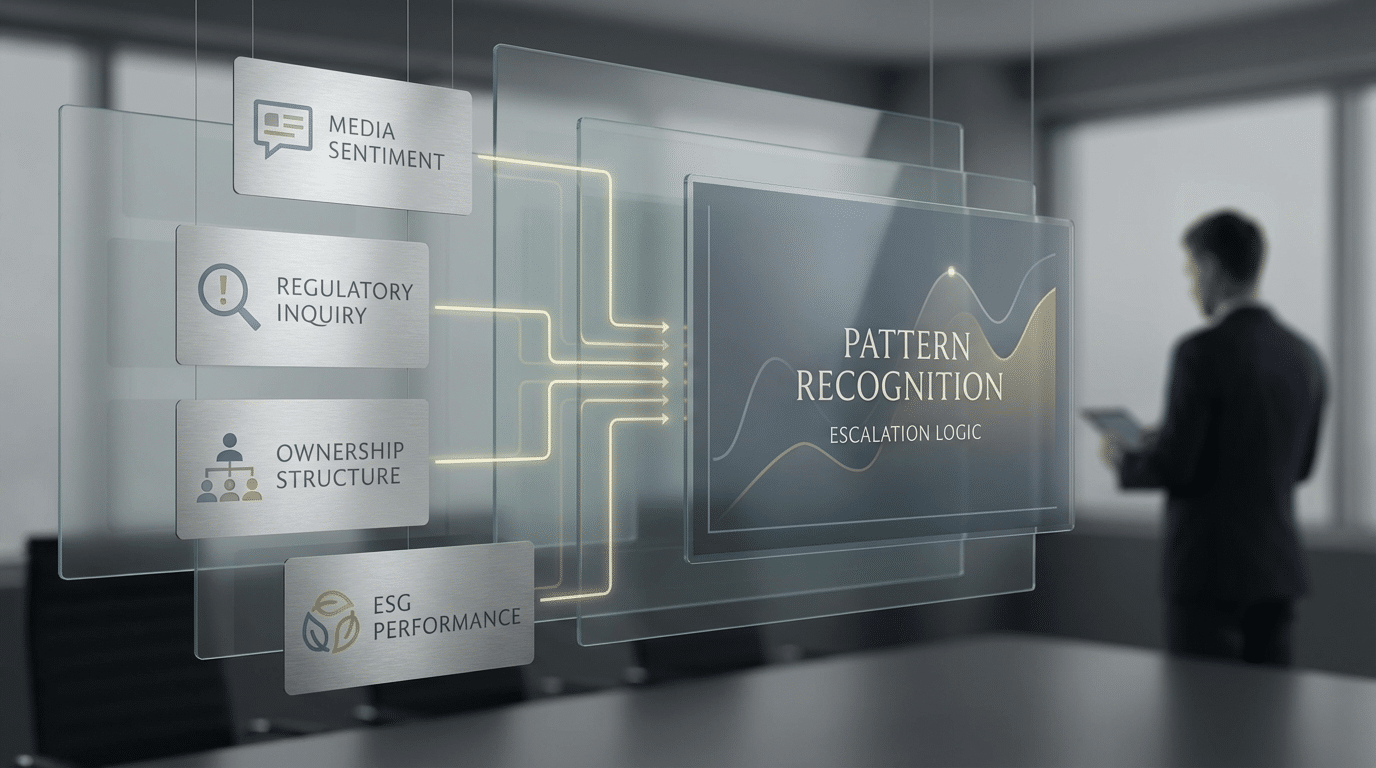
Effective vendor risk management is not a static process; it’s a dynamic, continuous cycle that spans the entire vendor lifecycle, from initial engagement to eventual offboarding. Modern VRM solutions are designed to provide continuous intelligence at every stage, ensuring that risks are identified, assessed, monitored, and mitigated proactively. This comprehensive approach contrasts sharply with traditional, point-in-time assessments, which quickly become outdated in a rapidly changing threat landscape.
The lifecycle typically begins with vendor onboarding, where initial due diligence and risk assessments are performed. This transitions into ongoing monitoring, which involves continuous evaluation of a vendor’s performance, security posture, and compliance. Finally, vendor offboarding ensures that relationships are terminated securely, with all data access revoked and contractual obligations met. Throughout this entire journey, VRM solutions leverage automation and advanced analytics to maintain a consistent, up-to-date risk profile for every vendor.
Advanced corporate intelligence and third-party risk management best practices
To truly excel in VRM, organizations are adopting advanced practices that harness the power of artificial intelligence (AI) and automation. AI agents are becoming indispensable, capable of automating high-volume tasks such as questionnaire distribution, evidence collection, and even the initial review of security documentation. For example, AI can summarize SOC 2 reports, highlight key flagged risks, and draft follow-up questions, significantly reducing manual effort. This frees up human analysts to focus on complex risk analysis and strategic decision-making.
Automated contract analysis, powered by Natural Language Processing (NLP), is another game-changer. These tools can extract critical clauses related to data protection, security requirements, and service level agreements, ensuring that contractual obligations are met and identifying potential areas of non-compliance. Customizable risk rubrics allow organizations to tailor scoring models to their specific risk appetite, ensuring that assessments are relevant and actionable. Furthermore, maintaining audit readiness is paramount, and VRM solutions provide centralized, immutable audit trails for all risk mitigation actions, demonstrating due diligence to regulators and internal stakeholders. This blend of automation and intelligent analysis represents the cutting edge of third-party risk management.
Vendor selection and GRC ecosystem integration
Choosing the right VRM solution requires careful consideration of an organization’s size, industry, and specific regulatory requirements. While many solutions offer similar core features, their strengths can vary significantly. Some excel in cyber risk monitoring, while others provide deeper insights into financial stability or regulatory compliance. Organizations should look for platforms that offer flexibility in customizing questionnaires, risk scoring models, and reporting dashboards to align with their unique risk framework.
A key differentiator for modern VRM solutions is their ability to integrate seamlessly with broader Governance, Risk, and Compliance (GRC) ecosystems, as well as Enterprise Resource Planning (ERP) platforms. This API connectivity allows for a unified view of risk across the enterprise, breaking down silos between different departments. By integrating VRM data into central risk registers, organizations can correlate vendor risks with overall enterprise risk, compliance programs, and even business continuity plans. This creates a holistic risk management framework, providing a single source of truth for all risk-related information. The benefits of this integration are clear when comparing manual versus automated VRM approaches:
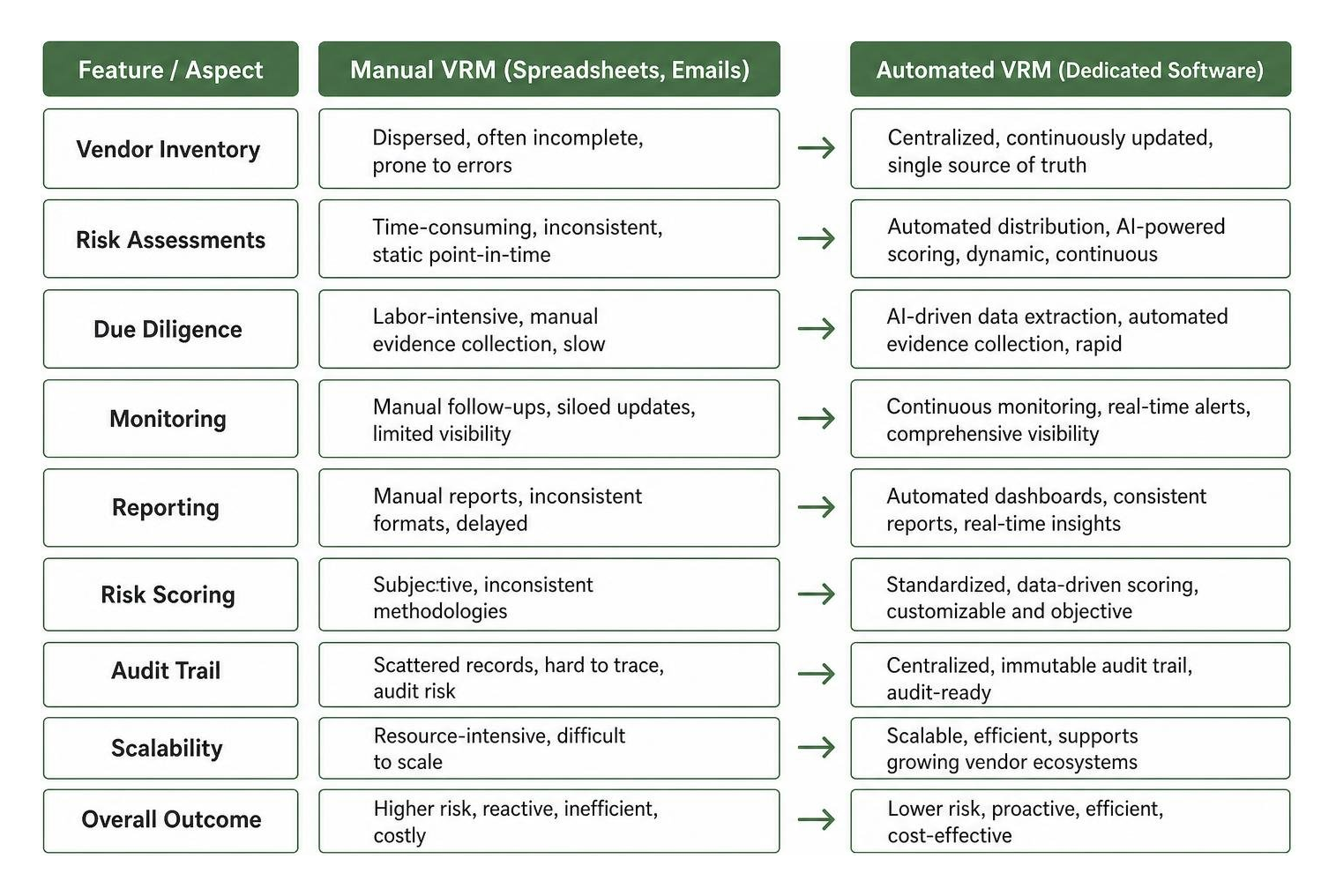
Feature / Aspect Manual VRM (Spreadsheets, Emails) Automated VRM (Dedicated Software) Vendor Inventory Dispersed, often incomplete, prone to errors Centralized, continuously updated, single source of truth Risk Assessments Time-consuming, inconsistent, static point-in-time Automated distribution, AI-powered scoring, dynamic, continuous Due Diligence Labor-intensive, manual evidence collection, slow AI-driven data extraction, automated evidence collection, rapid Monitoring Periodic, reactive, limited scope Continuous, real-time threat intelligence, proactive alerts Compliance Reporting Manual aggregation, prone to human error, difficult to audit Automated, audit-ready trails, customizable dashboards Resource Allocation High manual effort, security teams diverted from strategic tasks Reduced manual effort, teams focus on analysis and remediation Visibility Fragmented, siloed, limited enterprise-wide view Unified, holistic, real-time risk dashboards Scalability Difficult to scale with growing vendor base Highly scalable, efficient for large vendor ecosystems Incident Response Slow, reactive, manual correlation of data Rapid detection, automated alerts, streamlined response workflows Cost Savings Hidden costs in manual labor, potential for large breach fines Significant savings in time, reduced breach risk, improved ROI This comparison underscores the transformative impact of automated VRM solutions on operational efficiency, risk reduction, and overall governance.
Frequently asked questions
What is the role of corporate intelligence in vendor risk management?
Corporate intelligence is fundamental to robust vendor risk management. It moves beyond self-reported data by providing external, objective insights into a vendor’s profile. This includes data verification, ensuring that the information provided by the vendor is accurate and complete. External intelligence sources offer critical risk scoring, evaluating factors like financial stability, regulatory compliance history, and adverse media mentions that might not surface through direct questionnaires. Corporate intelligence enables continuous monitoring, allowing organizations to detect changes in a vendor’s risk posture in real-time, rather than relying on periodic, potentially outdated, assessments. It provides the crucial context needed to make informed decisions about vendor relationships.
How do automated platforms streamline third-party due diligence?
Automated platforms significantly streamline third-party due diligence by replacing manual, time-consuming processes with efficient, intelligent workflows. They leverage AI for data extraction from documents like SOC 2 reports and contracts, automatically populating assessment fields. Automated questionnaires can be dynamically generated and distributed based on a vendor’s risk tier, ensuring that the right questions are asked without unnecessary burden. Furthermore, these platforms centralize evidence collection, track responses, and automate follow-ups, drastically reducing the cycle time for assessments. This efficiency gain, with some organizations reporting up to 80% reduction in review time, allows for more frequent and comprehensive due diligence, improving overall risk coverage.
Why is continuous monitoring superior to annual vendor questionnaires?
Annual vendor questionnaires provide only a snapshot in time, making them inherently limited in a dynamic risk environment. Continuous monitoring, by contrast, offers real-time intelligence into a vendor’s evolving risk posture. It leverages external threat intelligence feeds, security ratings, and adverse media monitoring to detect changes as they happen. This means that if a vendor experiences a cyber incident, a financial downturn, or a regulatory violation, your organization is alerted promptly. This dynamic risk assessment allows for immediate action, such as re-evaluating the vendor relationship or implementing new controls, significantly reducing exposure and improving breach detection capabilities compared to waiting for the next annual review.
Conclusion
In 2026, navigating the complexities of third-party relationships demands a sophisticated and proactive approach to vendor risk management. The strategic value of robust VRM solutions, powered by corporate intelligence and advanced automation, cannot be overstated. They are essential for building operational resilience, protecting against escalating cyber and regulatory threats, and ultimately, securing an organization’s long-term success.
By adopting VRM solutions that offer unified visibility, streamline due diligence, and enable continuous monitoring, organizations can transform their approach to third-party risk. This shift from reactive to proactive governance not only reduces manual effort and enhances compliance but also provides a competitive edge in an increasingly interconnected world. Embracing these solutions is not just about mitigating risks; it’s about fostering secure, reliable, and strategically advantageous partnerships that contribute to overall enterprise security and growth.