

Inflation won’t blink: Markets face a new reality
Sponsored content. This article was supplied by a third party and Business Money has been paid to publish it.
 Inflation won’t blink: Why the Fed’s next move just got harder
The Federal Reserve enters September with an uncomfortable problem. Inflation remains above target, economic growth has continued, and policymakers are divided over whether interest rates are restrictive enough.
At its July meeting, the Federal Open Market Committee kept the federal funds rate at 3.50% to 3.75%. But the decision was hardly a signal that the debate is over. Three members preferred an immediate 25-basis-point increase, while expectations around the future path of rates have also shifted.
The significance extends beyond the next Federal Reserve announcement. Interest-rate expectations are closely connected with currencies, Treasury yields, equities, gold and broader financial conditions.
With inflation proving persistent, each new economic release adds another piece to an increasingly complicated picture.
Inflation is still the problem nobody can ignore
The Federal Reserve’s longer-term inflation objective remains 2%, but recent readings have been running considerably above that level.
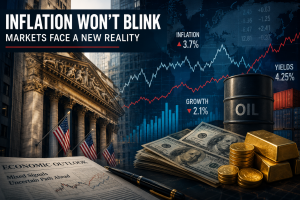
According to the Fed’s July meeting minutes, PCE inflation was running at 4.1% year-on-year in May, while core PCE inflation stood at 3.4%. Fed staff estimated headline PCE inflation moderated to around 3.7% in June, with core inflation at approximately 3.3%.
That represents some moderation, but inflation remains well above the Fed’s longer-term objective.
Energy prices have played a significant role in the recent inflation picture, while tariffs and other input costs have added pressure elsewhere. Price increases have also appeared across multiple categories, making the current inflation environment more complicated than a temporary increase in one area.
The debate facing policymakers is therefore increasingly difficult: inflation remains elevated while other parts of the economy provide their own, sometimes conflicting, signals.
One number rarely explains the economy
For Endo Ryuki, Senior Broker at MizoraTrade, the current environment demonstrates why individual economic releases are difficult to interpret in isolation.
“Inflation is still above the Federal Reserve’s objective, but one reading rarely defines the wider economic picture. What makes the current environment interesting is how inflation, employment, economic activity and central-bank communication interact. Markets are continuously reassessing that balance as new information arrives,” says Ryuki.
The distinction is important.
An inflation report provides information about prices. Employment figures provide information about labor conditions. Consumer data offers another view of economic activity.
Each describes a different part of the economy.
Sometimes those indicators reinforce one another. At other times, they point in different directions.
The Fed itself is divided
One of the more notable details from the July FOMC meeting was the disagreement inside the committee.
Most participants supported leaving rates unchanged. Several, however, favored a 25-basis-point increase, arguing that price pressures remained broad enough to justify a more restrictive stance.
Financial markets were simultaneously processing the changing policy environment.
According to the Federal Reserve’s account of financial conditions surrounding the meeting, market pricing had shifted toward expectations of tighter monetary policy, while Treasury yields had also risen largely because of higher real rates.
That illustrates an important feature of financial markets: expectations can change before an official policy decision occurs.
Currency markets reflect changing assumptions about relative interest rates. Bond yields incorporate views about inflation, growth and monetary policy. Equity valuations exist within the same interest-rate environment.
These relationships describe how different parts of the financial system interact. They do not establish what any individual market will do next.
Why expectations matter
Economic numbers are rarely interpreted only by comparing them with the previous month or year.
Expectations matter too.
“Two identical economic readings can produce very different market reactions depending on what investors expected beforehand,” Ryuki explains. “The headline tells you what happened. The market reaction often tells you whether that information was already anticipated.”
This helps explain why financial-market reactions can sometimes appear surprising.
A number that looks strong historically may already have been widely expected. Another that appears relatively ordinary may contain information that differs significantly from prior assumptions.
The reaction therefore provides information about expectations as well as the economic data itself.
Oil has complicated the inflation story
Energy is another part of the current picture.
The Federal Reserve’s July Monetary Policy Report noted that consumer energy prices had risen sharply following disruption connected to conflict in the Middle East.
Higher energy costs can extend beyond petrol stations. Transportation, production and other business costs can also be affected.
That creates a particularly complicated form of inflation for central banks.
Interest rates can influence demand, credit conditions and financial activity. They cannot create additional energy supplies or remove physical disruptions from international supply chains.
Policymakers therefore have to distinguish between temporary price shocks and pressures that could become more broadly reflected across the economy.
Oil consequently connects several economic discussions at once: energy supply, consumer prices, transportation costs, inflation and economic activity.
The dollar, gold and equities are reading the same economy differently
The same economic development can have different implications across financial markets.
A change in inflation can alter expectations surrounding interest rates. Changes in interest-rate expectations can be reflected in Treasury yields and currencies, while companies operate within the resulting borrowing and financing environment.
Gold has its own relationship with interest rates, currencies, inflation expectations and global uncertainty.
But none of these relationships is fixed.
Geopolitical events, previous expectations, economic growth and changing market conditions can alter how financial assets respond to similar information at different times.
For Ryuki, this is why economic context remains important.
“Economic analysis is less about trying to predict every market move and more about understanding what information the market is responding to. Inflation, labor conditions and policy expectations can change independently, so context becomes especially important when those signals begin pointing in different directions.”
September brings more information
The economic picture will continue developing as new inflation, employment, consumer and business data becomes available.
The Federal Reserve currently faces inflation above its longer-term objective while economic activity remains relatively solid. Policymakers themselves have expressed different views about the appropriate level of interest rates.
That disagreement is information in its own right.
It demonstrates that the economic picture is not producing a single obvious interpretation, even among the officials responsible for monetary policy.
New economic releases may reinforce some of the existing trends. Others may complicate them further.
For Endo Ryuki, that uncertainty is precisely why individual headlines tell only part of the story.
The next inflation number will provide another piece of information.
So will the next employment report, the next consumer-spending figure and the next Federal Reserve communication.
Understanding the economy means looking at how those pieces fit together, while recognizing that the picture can change as new information arrives.