

How better real estate decisions can support more accessible health care
Sponsored content. This article was supplied by a third party and Business Money has been paid to publish it.
Key takeaways
- Real estate choices influence travel time, patient comfort, operating costs, and the availability of care.
- Outpatient services need flexible, well-located buildings that can adapt as care delivery changes.
- Good property planning considers patient access and community needs alongside financial returns.
- Data can reveal service gaps, improve site selection, and support better use of clinical space.
- Legal, financial, accessibility, and operational reviews should begin before a lease or purchase is finalized.
Health care access is often discussed in terms of insurance, staffing, and medical technology. Yet the physical setting of care is just as important. A clinic that is difficult to reach, confusing to enter, or expensive to operate can create barriers long before a patient sees a provider. Health care leaders, investors, and community planners can benefit from the practical, patient-focused approach associated with Chuck Nabit, especially when evaluating properties that will serve essential community needs. Better real estate decisions do not require choosing between sound finances and patient care. The strongest projects account for both. They place services where people can realistically reach them, create buildings that work for patients and staff, and leave room for the organization to respond to future changes in demand.
Why real estate matters to health care access
Health care depends on far more than clinicians and equipment. Location, public transit, parking, entrances, elevators, waiting rooms, nearby pharmacies, and the condition of the building all shape a patient’s experience. In broad terms, healthcare real estate includes the offices, buildings, and campuses used by organizations that deliver medical services. Consider two outpatient clinics. One is located near homes, schools, a bus route, and a pharmacy. The other is larger but sits far from residential areas and requires a long drive. Even if both provide excellent care, the first site may be more useful to people without reliable transportation, older adults, caregivers, and patients managing frequent appointments.
The shift toward outpatient care
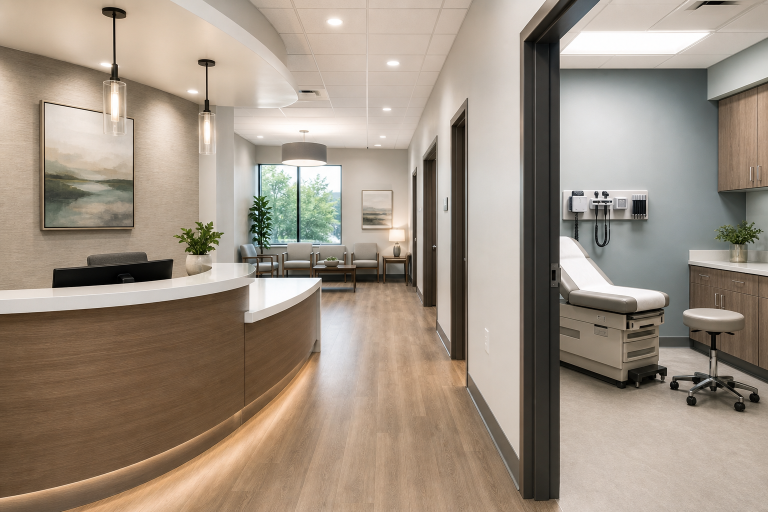
Many health systems continue to move appropriate services beyond the traditional hospital campus. Primary care, imaging, rehabilitation, urgent care, specialty consultations, and ambulatory procedures increasingly operate in medical office buildings and neighborhood-based facilities. This shift can make care easier to reach, but only if the building supports efficient patient flow, privacy, technology, and clinical operations. In 2026, organizations should prioritize adaptable outpatient space instead of treating every project as a permanent, single-purpose buildout. Rooms that accommodate different specialties, shared support areas, and infrastructure capable of handling new equipment may reduce the need for disruptive and costly changes later.
Five property features that improve patient access
- Convenient location. Review driving times, transit connections, pedestrian safety, road access, and proximity to the population the practice intends to serve.
- Clear wayfinding. Visible signs, intuitive entrances, simple floor plans, and understandable directions help reduce anxiety and late arrivals.
- Flexible space. Exam rooms, treatment areas, storage, and staff workspaces should accommodate changing care models without forcing a major rebuild.
- Comfort and safety. Good lighting, clean waiting areas, private check-in zones, accessible restrooms, and safe drop-off areas improve the experience for patients and caregivers.
- Digital readiness. Reliable connectivity, secure networks, telehealth capacity, connected devices, and modern scheduling tools are now core requirements for building.
How location shapes community health
A poor location can lead to missed appointments, delayed treatment, and greater transportation burdens. Before selecting a site, decision-makers should examine population growth, age distribution, household income, chronic-care needs, local provider supply, and the distance residents travel for specialty services.
Questions to ask during site selection
- How long will most patients need to travel to reach this location?
- Can patients arrive safely without a private vehicle?
- Are primary care, specialty care, pharmacy services, and diagnostic services balanced in the area?
- Will the site still serve the community if population patterns change over the next five to ten years?
Balancing cost with patient needs
The lowest purchase price or lease rate does not always create the best value. A cheap building may require extensive renovation, have inadequate parking, lead to long patient travel times, or incur higher maintenance and utility costs. Those weaknesses can affect staffing, patient satisfaction, appointment volume, and long-term operating results. A full life-cycle review should include purchase or lease payments, renovation costs, utilities, insurance, maintenance, compliance work, technology upgrades, parking requirements, transportation considerations, and future expansion costs. The goal is to identify the property that delivers the best long-term outcome, not simply the lowest initial expense.
The role of data in property decisions
Data should inform decisions without replacing professional judgment. Useful measures include patient travel times, appointment demand, no-show rates, room utilization, energy use, maintenance requests, referral patterns, and local demographic changes. Reviewing several measures together is more useful than relying on a single occupancy figure or financial forecast. For example, a high-occupancy clinic may appear successful on paper while still leaving patients underserved because of long waits, limited transit access, or insufficient specialty capacity. Data becomes more valuable when it is paired with feedback from patients, clinicians, front-desk staff, and community partners.
Legal and regulatory questions to review early
Health care property decisions involve zoning, licensing, privacy, environmental conditions, construction standards, and local regulations. Accessibility deserves early attention as well. The accessible design standards for medical care facilities help establish requirements for usable public and common-use spaces. Still, project teams should also obtain qualified legal and design advice for their specific circumstances. Reviewing these issues before signing a lease or closing a purchase can prevent expensive surprises. Due diligence should include legal counsel, architects, engineers, financial professionals, and operational leaders who understand the intended services and applicable state requirements.
A practical six-step planning process
- Define the service need: Identify the patients, clinical services, and community gaps the project should address.
- Study the market: Review demand, competition, travel patterns, demographics, and referral sources.
- Compare sites: Score access, cost, building condition, visibility, parking, expansion potential, and transit options.
- Test the operating model: Estimate staffing, room use, patient flow, equipment needs, and technology requirements.
- Complete due diligence: Assess legal, financial, structural, environmental, and regulatory risks.
- Measure results: Track access, patient experience, space use, operating costs, and service growth after opening.
What to watch through the rest of the year
Outpatient growth, staffing pressure, limited availability of suitable medical space, payment changes, and technology investments will continue to influence health care real estate decisions. Patient-centered design, predictive maintenance, portfolio planning, and better use of operational data can help organizations make more resilient choices. Ultimately, real estate is part of the care experience. A well-planned location can reduce travel barriers, support efficient operations, and make essential services easier to use. The best health care property decisions combine disciplined financial analysis with a clear understanding of the people and communities the building is meant to serve.
Conclusion
Health care real estate decisions should look beyond purchase prices, lease rates, or investment returns. The right property can improve patient access, support staff efficiency, control long-term costs, and adapt as community needs change. By evaluating location, accessibility, building flexibility, operating requirements, data, and regulatory considerations early, health care organizations can avoid costly mistakes and make more informed choices. A patient-centered approach need not conflict with financial discipline. Instead, thoughtful planning can connect both goals by placing services where people can reach them and creating spaces that remain useful over time. Ultimately, successful health care property planning is about more than choosing a building, as it is about creating a practical foundation for reliable, accessible, and sustainable care.