

Performance-based funding for fast ERC relief
Sponsored content. This article was supplied by a third party and Business Money has been paid to publish it.
Maximizing your business potential with employee retention credit advisory
Understanding the role of an employee retention credit advisory
The Employee Retention Credit (ERC) was a cornerstone of federal relief during the economic upheaval of the early 2020s, offering eligible businesses substantial tax credits for retaining employees. However, the path to claiming these credits is far from straightforward. This is where a specialized tax credit advisory plays a critical role, acting as an indispensable guide through a labyrinth of complex regulations and evolving interpretations.
The primary function of an ERC advisory is to meticulously assess a business’s eligibility, a process that often involves navigating intricate criteria. Unlike simpler tax deductions, ERC eligibility hinges on specific economic impacts experienced during the pandemic. Businesses typically qualify in one of two ways: either by demonstrating a significant decline in gross receipts during specified quarters of 2020 or 2021 compared to 2019, or by proving they experienced a full or partial suspension of operations due to a government order limiting commerce, travel, or group meetings.
For the gross receipts test, an advisory firm meticulously analyzes quarterly financial statements, often requiring detailed comparisons to pre-pandemic performance. This isn’t just about comparing top-line numbers; it involves understanding the specific revenue streams and their qualification under IRS guidelines. For the government order mandate, the advisory must delve into the specific local, state, or federal orders that impacted the business, determining if the impact was more than a nominal effect on operations. This requires a deep understanding of both tax law and the operational realities of various industries.
Beyond initial qualification, a crucial aspect of an advisory’s work is ensuring comprehensive compliance oversight. The IRS has been clear that it will scrutinize ERC claims, and businesses must be prepared to substantiate every aspect of their application. This includes maintaining robust documentation, understanding the nuances of qualified wages (which can differ based on the size of the employer and the period), and correctly applying aggregation rules for related entities. An advisory ensures that all these moving parts are meticulously managed, reducing the risk of future inquiries or adverse outcomes.
The complexity of these rules, coupled with the significant financial stakes involved, underscores why businesses increasingly turn to expert advisories. They offer not just a service, but a partnership dedicated to maximizing legitimate claims while rigorously upholding compliance standards.
Core functions of an employee retention credit advisory
The process of claiming the Employee Retention Credit is not merely about identifying eligibility; it involves a detailed, multi-faceted approach to computation and substantiation. An ERC advisory performs several core functions to ensure accuracy and compliance throughout this journey.
One of the most critical tasks is precise wage calculation. For each eligible quarter, the advisory must determine which wages qualify for the credit. This isn’t as simple as total payroll. It involves distinguishing between wages paid to employees who were actively working and those who were not, especially for larger employers. For smaller businesses (generally those with 500 or fewer full-time employees in 2019), all wages paid to employees during a period of suspension or significant decline in gross receipts typically qualify. For larger employers, only wages paid to employees for not providing services qualify. This distinction is vital and requires careful analysis of payroll records, timekeeping data, and employee activity logs.
Furthermore, qualified wages extend beyond just cash compensation. They also include the employer’s share of healthcare expenses paid on behalf of employees. An advisory meticulously reviews health insurance statements, benefit plans, and related documentation to accurately incorporate these costs into the credit calculation. This often involves prorating expenses for eligible periods and ensuring that only the employer’s contribution is counted.
Perhaps the most exhaustive function is documentation review. The IRS mandates that businesses retain thorough records to support their ERC claims for at least four years after the date the taxes are due or paid, whichever is later. An advisory guides clients on what documentation is necessary, which typically includes:
- Payroll records (Form 941, W-2s)
- Proof of gross receipts decline (financial statements, sales reports)
- Copies of government orders and evidence of their impact on operations
- Records of healthcare expenses
- Documentation supporting the number of full-time employees in 2019
- Any other relevant financial or operational data.
Advisories don’t just collect these documents; they review them for consistency, accuracy, and completeness, ensuring they align with the credit calculations. This proactive approach is essential for preparing businesses for potential IRS inquiries or audits, providing a robust defense for the claim.

This rigorous documentation and calculation process is fundamental. Without it, even a legitimately eligible business could face challenges in defending its claim, potentially leading to penalties or the need to repay the credit. The advisory’s expertise transforms a complex, high-stakes task into a structured, defensible process.
How an employee retention credit advisory mitigates filing risks
The allure of the Employee Retention Credit (ERC) is undeniable, offering substantial financial relief to businesses. However, the complexity of the program also presents significant risks, particularly given the IRS’s heightened scrutiny. An experienced ERC advisory is crucial in mitigating these risks, safeguarding businesses from potential pitfalls.
One of the most pressing concerns for businesses is IRS audit protection. The IRS has publicly stated its intention to increase enforcement actions related to ERC claims, particularly those filed by aggressive promoters who may have encouraged ineligible businesses to apply. An advisory firm, through its meticulous eligibility assessment, precise calculations, and robust documentation review, builds a strong, defensible case for each claim. This proactive preparation significantly reduces the likelihood of an audit and, if one occurs, provides the necessary evidence to withstand scrutiny. They ensure that the business has not fallen prey to the “aggressive promoters” who often overstate eligibility or misinterpret the rules, leading to fraudulent or erroneous claims.
Another critical risk factor stems from the nuances of qualifying events, especially the “partial suspension” test. Many businesses struggled with supply chain disruption during the pandemic, but proving that these disruptions constituted a government-mandated partial suspension requires careful analysis. An advisory helps differentiate between general economic hardship and a direct impact from a government order, preventing businesses from claiming credits based on insufficient grounds. Misinterpreting these rules can lead to significant penalty avoidance issues down the line.
The consequences of an erroneous claim can be severe. Beyond merely repaying the credit, businesses could face significant penalties, including accuracy-related penalties (20% of the underpayment), civil fraud penalties (75% of the underpayment), and even criminal charges in extreme cases. An advisory’s expertise ensures that claims are legitimate and accurately calculated, helping businesses avoid these punitive measures. This is particularly important concerning the clawback risk, where the IRS may demand repayment of the credit years after it was initially received, often with interest and penalties. Without proper substantiation, businesses could find themselves in a precarious financial position.
An ERC advisory acts as a shield, protecting businesses from the multifaceted risks associated with this complex tax credit. Their comprehensive approach, from initial assessment to documentation and audit readiness, provides peace of mind and ensures that businesses can confidently leverage the ERC as intended, without fear of future repercussions.
Strategic solutions for IRS delays and liquidity challenges
As of August 2026, one of the most significant challenges facing businesses that have filed for the Employee Retention Credit (ERC) continues to be the prolonged IRS processing backlog. Despite the program’s closure to new applications for most periods, the sheer volume of claims filed in 2020 and 2021 has overwhelmed the agency, leading to extensive delays in the disbursement of credits. This ongoing IRS processing backlog has created a liquidity crisis for many businesses, especially small and medium-sized enterprises (SMEs) that were counting on these funds to stabilize operations, invest in growth, or manage existing debts.
The IRS has openly acknowledged the backlog, citing staffing shortages, the complexity of the claims, and the need for thorough review to combat fraudulent submissions. This situation has been exacerbated by the moratorium on new ERC claims processing, which the IRS implemented in September 2023. While intended to allow the agency to catch up and focus on fraudulent claims, it has inadvertently extended the waiting period for legitimate businesses, turning anticipated cash infusions into agonizingly slow trickles.
For businesses operating on tight margins, this cash flow acceleration delay can be detrimental. It impacts their ability to meet payroll, invest in inventory, launch new projects, or simply maintain a healthy operational runway. The difference between receiving a multi-six-figure credit today versus in another 12-18 months can be the difference between thriving and merely surviving.
To illustrate the stark reality of these delays, consider the following comparison:
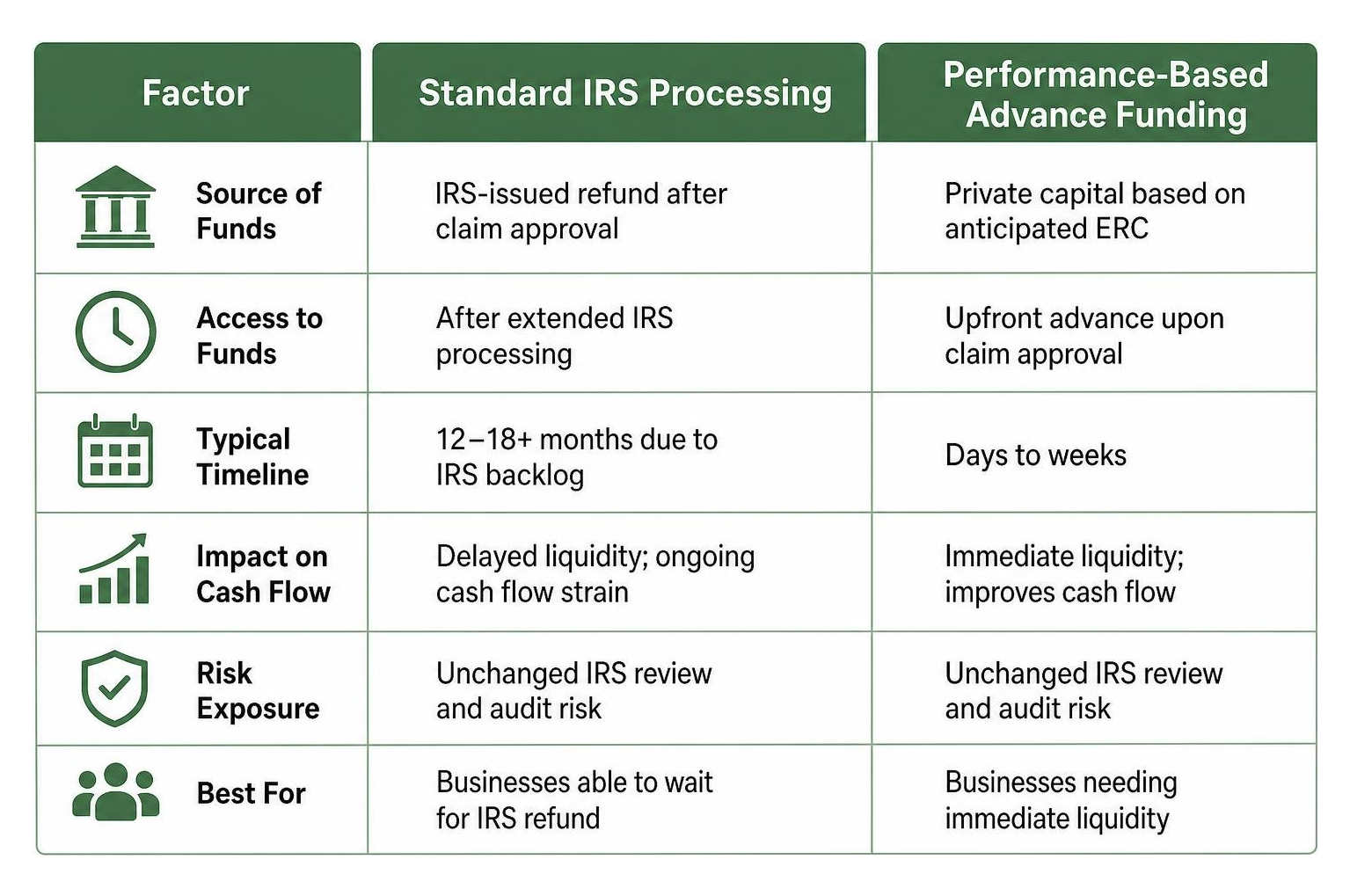
Given these protracted timelines, many businesses are actively seeking ways to bridge this funding gap. Traditional lenders are often hesitant to provide financing against an uncertain IRS payout. This has paved the way for innovative financial solutions designed to provide immediate liquidity. For businesses looking to secure their funds without the lengthy wait, specialized services exist to help expedite Employee Retention Credit payouts. These services offer a lifeline, transforming a future tax credit into present-day working capital, allowing businesses to maintain momentum despite the IRS’s operational challenges.
Performance-based funding and alternative capital options
In light of the persistent IRS processing delays, businesses are increasingly exploring alternative capital options, with Performance-based funding emerging as a particularly attractive solution. This innovative approach directly addresses the liquidity crunch caused by the ERC backlog, providing businesses with immediate access to a significant portion of their anticipated tax credit.
Unlike traditional loans, Performance-based funding in this context often takes the form of non-recourse advances. This means that the funding provider assumes the risk associated with the IRS payout. If, for some unforeseen reason, the IRS reduces or denies the claim (which is highly unlikely for claims meticulously prepared by a reputable advisory), the business generally does not have to repay the advance. This significantly de-risks the capital injection for the business, offering a level of financial security that conventional bridge financing might not.
The fee structures for these performance-based advances are typically tied to the successful retrieval of the ERC. Instead of fixed interest rates, fees might be a percentage of the advanced amount or a share of the final credit received. This alignment of interests ensures that the funding partner is incentivized to see the claim successfully processed and disbursed.
The primary benefit of such models is immediate cash flow. Businesses can utilize these funds to strengthen their balance sheet health, address urgent operational needs, or seize growth opportunities that might otherwise be missed due to delayed ERC payments. This risk mitigation strategy allows businesses to convert a future asset into current capital, providing a crucial buffer against economic uncertainties and operational pressures. It’s a pragmatic approach for businesses that cannot afford to wait indefinitely for federal processing.
Local business insights: ERC funding in Travis County
The economic landscape of Travis County, Texas, particularly its vibrant hub of Austin, provides a compelling case study for the impact and necessity of Employee Retention Credit (ERC) funding. Known for its rapid Austin business growth, diverse industries ranging from tech to hospitality, and a dynamic workforce, businesses in this region were significantly affected by the pandemic’s economic shifts.
During the eligible periods of 2020 and 2021, many businesses across Travis County experienced the qualifying gross receipts declines or government-mandated suspensions that made them eligible for the ERC. For these enterprises, the credit represented a vital lifeline, helping them maintain their Travis County payroll, retain skilled employees, and weather the storm. The regional economic impact of these credits cannot be overstated; they helped preserve countless jobs and supported the continuity of local businesses that form the backbone of Austin’s prosperity.
As of August 2026, while the local economy continues its robust recovery, the delayed ERC payouts remain a concern for many. Businesses that filed claims years ago are still awaiting funds, which could significantly bolster their local enterprise resilience. For a tech startup looking to scale, a restaurant chain aiming to expand, or a service provider seeking to upgrade equipment, these deferred funds represent lost opportunities or prolonged financial strain.
The ability to access these credits through performance-based funding mechanisms is particularly valuable in a competitive market like Austin. It allows businesses to accelerate their growth plans, invest in new talent, or expand their footprint without waiting for the slow grind of federal bureaucracy. This immediate access to capital can be a game-changer, enabling local businesses to stay ahead, adapt to evolving market demands, and continue contributing to the unique economic vibrancy of Travis County.

The strategic use of ERC funds, whether directly from the IRS or through advance funding, empowers these businesses to not only recover but to thrive, reinforcing the strong entrepreneurial spirit that defines the Austin area.
Optimizing capital allocation following credit retrieval
Once a business successfully retrieves its Employee Retention Credit funds—either directly from the IRS or through an advance funding mechanism—the next critical step is the strategic capital reallocation of these newly acquired resources. This is not merely about depositing a check; it’s an opportunity to fortify the business’s financial health, stimulate growth, and build resilience for the future. The way these funds are allocated can significantly impact a business’s long-term trajectory.
For many businesses, the immediate priority might be to bolster their employee retention efforts. The ERC was designed to keep people employed, and reinvesting a portion of the credit back into the workforce aligns perfectly with its original intent. This could involve offering competitive wages, enhancing benefits, or investing in employee development programs.
Another common and prudent allocation strategy is to extend the operational runway. This means building up cash reserves to cover several months of operating expenses, providing a crucial buffer against unexpected market fluctuations or economic downturns. A longer runway offers flexibility and reduces the pressure of short-term financial demands, allowing leadership to make more strategic, long-term decisions.
For businesses carrying debt, the ERC funds present an excellent opportunity for debt restructuring or accelerated repayment. Reducing high-interest debt can significantly improve cash flow, lower financial risk, and free up capital for other investments. This strategic move can dramatically improve a company’s financial ratios and creditworthiness.
The goal is to transform the temporary relief of the ERC into sustainable business growth. This requires a thoughtful approach, often guided by financial advisors, to ensure that the funds are deployed in a way that maximizes their impact and aligns with the company’s overarching strategic objectives.

Workforce reinvestment and operational expansion
The successful retrieval of Employee Retention Credit funds provides a golden opportunity for businesses to strategically reinvest in their most valuable asset: their workforce, and simultaneously pursue operational expansion. This dual focus can lead to significant and sustainable growth.
From a workforce reinvestment perspective, the funds can be channeled into several key areas. Talent acquisition becomes easier when a business can offer more competitive compensation packages, attracting top-tier professionals who might otherwise opt for larger corporations. Beyond new hires, existing employee retention can be significantly boosted through wage increases, performance bonuses, or enhanced benefits packages. This not only rewards loyalty but also motivates higher productivity and reduces turnover costs. Furthermore, investing in training programs for current staff ensures that the workforce remains skilled, adaptable, and ready for future challenges, fostering long-term workforce resilience. These investments signal to employees that they are valued, building a stronger, more committed team.
Simultaneously, these funds can fuel crucial operational expansion initiatives. This might involve upgrading technology and infrastructure, which can lead to increased efficiency and capacity. Businesses could invest in new equipment, open additional locations, or expand their product and service offerings. Such expansions directly contribute to enterprise capacity, allowing the business to serve more customers, enter new markets, or streamline existing processes. For instance, a manufacturing company might invest in automation, while a service-based business might develop a new digital platform.
The strategic deployment of ERC funds in these areas transforms a one-time tax credit into a catalyst for ongoing development. It allows businesses to not only recover from past economic challenges but also to position themselves for future success, creating a more robust and competitive entity.
Integrating tax credits into long-term financial planning
Beyond immediate liquidity and reinvestment, the Employee Retention Credit, once retrieved, should be thoughtfully integrated into a business’s long-term financial planning. This involves more than just a one-time accounting entry; it requires a strategic perspective on how this capital injection affects future corporate budgeting, tax liabilities, and overall financial health.
Firstly, the funds from the ERC should influence future corporate budgeting. Businesses can allocate a portion of these funds to build stronger reserves, providing a safety net against unforeseen economic shifts or operational challenges. This enhances financial stability and reduces reliance on short-term borrowing. It also allows for more aggressive budgeting towards growth initiatives, knowing that a solid financial foundation is in place.
Secondly, businesses must consider the impact of ERC on future tax liabilities. While the credit itself is a reduction in payroll taxes, the wages used to calculate the credit are not deductible for income tax purposes. This means that businesses may need to amend prior-year income tax returns (e.g., Form 1120 for corporations) to reduce their wage expense deduction, potentially increasing their taxable income for those years. An advisory firm can help navigate these complexities, ensuring proper coordination between payroll and income tax filings. This foresight is crucial for accurate financial forecasting and avoiding unexpected tax burdens.
Finally, the retrieved ERC capital can be strategically earmarked for capital expenditure. This could include investments in property, plant, and equipment (PP&E) that support long-term growth objectives, such as expanding facilities, purchasing advanced machinery, or developing new intellectual property. By using the ERC for these investments, businesses can fund significant projects without incurring additional debt, promoting sustainable growth.
Integrating the ERC into long-term financial planning transforms it from a temporary relief measure into a strategic asset that underpins future stability, growth, and overall financial resilience. It allows businesses to leverage a past benefit for future prosperity.
Frequently asked questions about employee retention credit
Navigating the intricacies of the Employee Retention Credit can raise numerous questions for business owners. Here, we address some of the most common inquiries, providing clarity on complex eligibility, managing delays, and understanding tax implications.
How does an advisory firm determine complex eligibility?
Determining complex ERC eligibility goes far beyond a simple checklist; it requires a deep dive into a business’s specific circumstances and a nuanced understanding of IRS guidelines. Advisory firms employ a multi-faceted approach:
First, they conduct a thorough nominal impact evaluation. For businesses claiming eligibility through a government order, the advisory assesses whether the order caused a “more than nominal” impact on the business’s operations. This isn’t just about whether the business was open or closed, but how the order affected its ability to conduct business, supply chain, or capacity to serve customers. They examine specific government mandates (e.g., capacity restrictions, travel bans, supplier shutdowns) and their direct, quantifiable effect on the business.
Second, for the revenue decline metrics, advisory firms meticulously analyze quarterly gross receipts. This involves comparing specific quarters in 2020 and 2021 to the corresponding quarters in 2019. They ensure proper accounting methods are applied, especially for businesses with unique revenue recognition patterns, and help identify any adjustments needed for related entities under aggregation rules.
Third, they apply partial suspension tests. This is often the most complex area. An advisory will analyze the specific government orders, the business’s operations before and after the order, and quantify the portion of the business that was suspended. They look for specific examples where a government order prevented the business from performing a significant portion of its normal operations, even if other parts remained open. This requires detailed operational data, such as sales figures by department, employee hours by function, and supply chain records.
Finally, they guide businesses through accurate payroll reporting. This involves identifying all qualified wages, including health plan expenses, for eligible employees during the qualifying periods. They ensure that wages are correctly attributed to the right quarters and that any Paycheck Protection Program (PPP) loan forgiveness does not overlap with ERC wage claims. This meticulous process ensures that the claim is not only eligible but also fully substantiated and defensible.
What options exist for businesses facing prolonged IRS processing delays?
As of August 2026, the IRS processing backlog for ERC claims continues to be a significant concern for many businesses. While waiting for the IRS to disburse funds, businesses have several options to address their immediate liquidity needs:
One common approach is to seek tax advance loans. These are typically short-term loans provided by specialized lenders that use the anticipated ERC refund as collateral. The loan amount is usually a percentage of the expected refund, and repayment is made directly from the IRS disbursement once it arrives.
Another option is bridge capital. This refers to various forms of interim financing designed to cover a funding gap until a more permanent solution (in this case, the ERC refund) materializes. Bridge capital can come from traditional lenders, private equity, or specialized financial institutions. It may be secured or unsecured, depending on the business’s creditworthiness and the lender’s policies.
Performance-based funding has emerged as a particularly attractive solution, as discussed earlier. These are often non-recourse advances where a funding provider offers immediate capital based on the strength and validity of the ERC claim. The repayment, along with a fee, is contingent on the successful receipt of the IRS refund, shifting the risk away from the business. This model is ideal for businesses that have a well-documented and robust ERC claim.
Finally, businesses can utilize claim status tracking services. While this doesn’t directly provide capital, it offers crucial transparency. Specialized advisory firms can help monitor the status of ERC claims with the IRS, providing businesses with more accurate timelines and helping them plan their finances more effectively. This proactive monitoring can also help identify and address any issues that might further delay processing.
Each of these options has its own costs and benefits, and the best choice depends on the business’s specific financial situation, the size of the anticipated refund, and its urgency for capital.
How do ERC funds affect subsequent federal tax filings?
The receipt of Employee Retention Credit funds has specific implications for subsequent federal tax filings, particularly regarding income tax. It’s crucial for businesses and their CPAs to coordinate closely to ensure compliance and avoid issues.
The primary impact relates to the deductibility of wages. The ERC is a payroll tax credit, but the wages used to calculate the credit are not deductible for federal income tax purposes. This means that if a business claimed the ERC for wages paid in 2020 or 2021, it must reduce its wage deduction on its federal income tax return for the year in which those wages were paid.
For example, if a business claimed ERC for wages paid in Q3 2021, and those wages were originally deducted on its 2021 income tax return (e.g., Form 1120 for corporations, Form 1065 for partnerships, or Schedule C for sole proprietors), that 2021 income tax return will need to be amended. This is done by filing an amended income tax return (e.g., Form 1120-X for corporations). The purpose of this amendment is to reduce the wage expense deduction by the amount of the ERC received. This reduction in deductible expenses will typically result in an increase in taxable income for the year the wages were paid, potentially leading to additional income tax liability.
This adjustment is generally required for the year the wages were paid, not the year the ERC refund is actually received. This can create complexities, especially if the ERC refund is received in a much later tax year (as is often the case with the current IRS backlog).
Therefore, careful CPA coordination is essential. A business’s CPA needs to be fully aware of the ERC claim amount, the quarters for which it was claimed, and the timing of the refund. They will then advise on the necessary amended income tax returns and ensure that all adjustments are properly made to avoid penalties and maintain compliance with IRS regulations. This integration of ERC into overall tax strategy is a critical component of post-credit continuity.
Conclusion
In the evolving landscape of post-pandemic business, the Employee Retention Credit (ERC) has proven to be a vital financial lifeline for countless enterprises. However, securing and optimally utilizing these funds requires more than just eligibility; it demands a sophisticated approach to strategic capital management.
The expertise of an Employee Retention Credit advisory is indispensable in navigating the complexities of eligibility, ensuring meticulous documentation, and mitigating the significant risks associated with IRS scrutiny. Their role extends from precise wage calculations to providing robust audit protection, safeguarding businesses from potential penalties and clawback risks.
As businesses continue to contend with the protracted IRS processing backlog, innovative solutions like Performance-based funding offer crucial liquidity. These non-recourse advances provide immediate access to capital, transforming anticipated future credits into present-day operational funds, preserving cash flow and fostering local enterprise resilience, particularly in dynamic economic hubs like Travis County.
Once retrieved, the strategic allocation of ERC funds becomes paramount. Whether directed towards workforce reinvestment, operational expansion, or debt restructuring, these funds represent an opportunity to drive sustainable business growth and enhance long-term financial planning. Integrating these tax credits into corporate budgeting and understanding their impact on future tax liabilities are critical steps towards ensuring post-credit continuity.
Leveraging the ERC effectively is about more than just receiving a refund; it’s about transforming a temporary relief measure into a strategic asset that underpins regulatory compliance, strengthens financial resilience, and fuels the sustained growth of your business.