

Digital marketing and AI automation: Smart growth
Sponsored content. This article was supplied by a third party and Business Money has been paid to publish it.
Leveraging digital marketing and AI automation for growth
Introduction

The landscape of digital marketing is changing rapidly. Businesses today face constant pressure to deliver personalized experiences and achieve better results with fewer resources. This is where the power of digital marketing and AI automation comes in. It is no longer enough to simply automate tasks; we need intelligent systems that can learn, adapt, and optimize our efforts in real time. Modern buyers expect instant relevance, consistent touchpoints across omni-channel journeys, and tailored messaging that anticipates their specific pain points before they even articulate them.
We believe that embracing AI automation is crucial for staying competitive and fostering sustainable growth. It helps us streamline operations, understand our customers better, and make faster, data-informed decisions. Rather than relying on gut feeling or delayed monthly reporting, marketing teams equipped with machine learning and intelligent automated workflows can analyze behavioral signals in fractions of a second. This article will explore how AI transforms traditional marketing automation. We will look at its benefits, operational risks, and practical ways to implement it for businesses of all sizes.
The most effective use of AI in marketing is not about replacing strategy, empathy, or creative judgment. It is about removing repetitive friction so skilled teams can focus on sharper positioning, stronger offers, better storytelling, and more meaningful customer relationships. AI can draft, score, sort, summarize, and recommend, but people still need to decide what the brand stands for, which audiences matter most, and how to communicate value responsibly. This balance is especially important because customers can quickly sense generic automation. When AI is guided by a clear voice, strong data standards, and a thoughtful customer experience strategy, automation feels helpful rather than intrusive.
Many forward-thinking companies are already seeing significant gains across key performance indicators. For example, some have cut ad budgets by 30% while doubling conversions, thanks to AI’s real-time programmatic bidding and audience adjustments. Others have dramatically sped up campaign creation cycles from weeks down to mere hours. The impact stretches across every phase of customer acquisition and retention—from hyper-targeted lead generation and adaptive nurturing sequences to autonomous post-purchase loyalty workflows.
For small and mid-sized businesses, these advantages are particularly valuable because AI can help lean teams compete with larger organizations. A smaller company may not have dedicated analysts, copywriters, media buyers, lifecycle marketers, and conversion specialists on staff. However, with the right automation stack, it can centralize customer data, identify promising leads, personalize follow-ups, test creative variations, and monitor campaign performance without expanding headcount at the same pace as growth. This does not eliminate the need for expertise; instead, it helps teams apply their expertise more consistently across every campaign, channel, and customer segment.
Operationally, AI automation also improves the speed of learning. Traditional campaigns often depend on long planning cycles, manual setup, and post-campaign reports that arrive too late to influence active performance. AI-supported workflows can detect early signals, such as rising cost per acquisition, declining engagement, abandoned carts, or increased interest from a specific segment, and recommend adjustments while there is still time to act. Over time, these feedback loops create a compounding advantage: each customer interaction produces more data, each data point improves the model, and each model improvement helps the next campaign perform better.
At the same time, transitioning to an automated ecosystem demands a thoughtful approach to brand governance, data security, and ethical messaging. Simply layering algorithms on top of disjointed legacy workflows creates confusion and brand dilution. Navigating this evolution requires strategic alignment, clean data infrastructure, and an acute understanding of modern branding and marketing services in an AI-driven world. When technology and authentic human creativity work synchronously, organizations can maintain brand distinctiveness while scaling outreach effortlessly. Join us as we uncover how AI can unlock unprecedented levels of efficiency and effectiveness for your marketing efforts, empowering your team to build deeper customer relationships and capture sustainable market share.
To make that transition practical, businesses should begin with focused use cases rather than attempting to automate everything at once. High-impact starting points often include lead scoring, email segmentation, ad creative testing, customer support triage, content repurposing, and churn prediction. These areas usually have measurable outcomes, accessible data, and repeatable workflows, making them ideal for early experimentation. Once teams validate the results, they can expand into more advanced applications such as dynamic pricing signals, account-based marketing orchestration, predictive budget allocation, and autonomous lifecycle campaigns. A phased approach reduces risk, builds internal confidence, and gives teams time to establish governance processes before automation becomes deeply embedded in daily operations.
Clear measurement is equally important. AI initiatives should be evaluated against business outcomes, not novelty. Useful metrics may include conversion rate, pipeline velocity, customer acquisition cost, retention rate, average order value, customer lifetime value, time saved per campaign, and content production efficiency. Teams should also monitor qualitative indicators, such as brand consistency, customer satisfaction, and sales team feedback. By combining quantitative performance data with human review, organizations can ensure AI automation supports both revenue growth and long-term trust.
The evolution of digital marketing and AI automation
The journey of digital marketing automation has moved significantly beyond simple scheduled tasks. What began as basic email triggers and social media scheduling has evolved into sophisticated systems powered by machine learning (ML), natural language processing (NLP), and predictive analytics. Today, AI-driven automation enables autonomous decision-making, providing unparalleled operational agility and workflow orchestration that was once unimaginable.
This evolution is fundamentally reshaping how we approach marketing. Instead of merely executing pre-defined rules, modern AI marketing automation continuously learns from vast datasets, identifies patterns, and makes real-time adjustments to optimize performance. This shift allows us to move from reactive campaign management to proactive, adaptive strategies that respond instantly to market dynamics and customer behavior. The goal is to embed continuous intelligence into every step of the marketing process, from data analysis to execution and optimization.
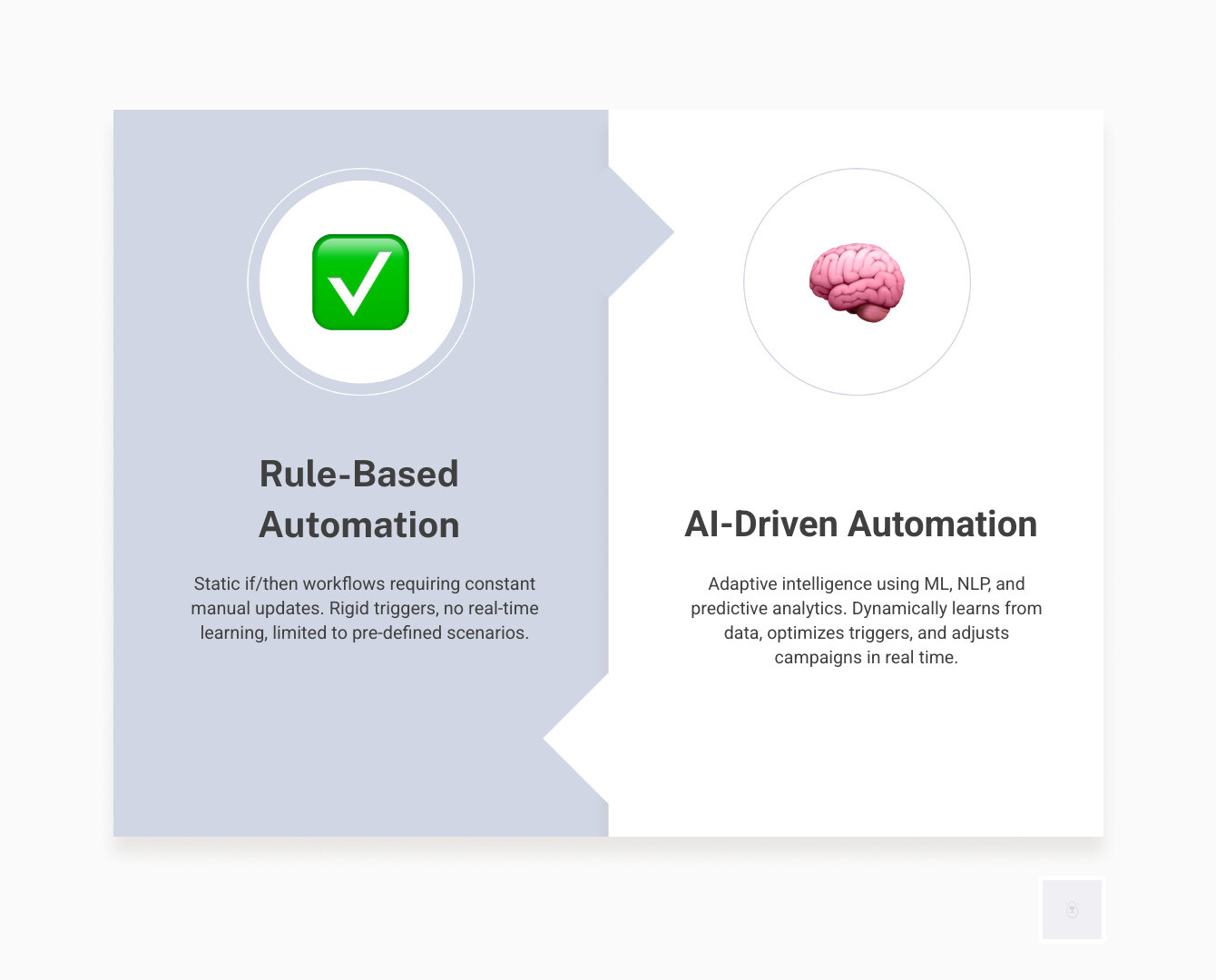
Shifting from rule-based logic to adaptive intelligence
Traditional marketing automation systems operate on static, human-defined “if/then” rules. For example, “if a user signs up, then send a welcome email.” While effective for basic tasks, these workflows lack the flexibility to adapt to nuanced customer behaviors or rapidly changing market conditions. They are rigid and require constant manual oversight, segment rebuilding, and manual updates.
In contrast, AI marketing automation introduces dynamic learning and continuous iteration. It moves beyond pre-programmed triggers to leverage real-time data, allowing systems to dynamically adjust messaging, timing, and even audience segments. This enables trigger optimization and continuous adaptation, leading to more relevant interactions and higher conversion rates. The system learns from every interaction, continually refining its approach to maximize engagement and business outcomes. This means that instead of simply sending an email three days after a signup, an AI system might analyze a user’s recent browsing history, past purchases, device preferences, and even external market trends to determine the optimal time, message, and channel for the next interaction.
Partnering with a specialized AI-native growth agency can help organizations establish these advanced capabilities quickly without getting bogged down in complex technical debt. Modern growth teams utilize continuous machine learning feedback loops to ensure every piece of customer data feeds directly into campaign refinement, driving higher return on ad spend (ROAS) and reducing customer acquisition costs across the funnel.
Core mechanics: Generative, predictive, and agentic systems
The intelligence behind modern AI marketing automation is built upon three core pillars:
- Generative AI: This technology, often powered by large language models (LLMs) and diffusion models, excels at creating multi-format content. From drafting compelling ad copy and social media posts to generating personalized email subject lines, interactive assets, and comprehensive SEO-optimized content creation, generative AI significantly accelerates production workflows. It can produce multiple variations of creative assets, allowing for rapid multivariate testing and optimization. A finance company, for instance, can now create four distinct marketing campaigns in under six weeks, a task that previously took eight weeks for just one campaign.
- Predictive analytics: By analyzing historical and real-time data, predictive AI forecasts future customer behavior, market trends, and campaign performance. This allows marketers to anticipate needs, identify high-value segments, and proactively intervene to prevent churn or capitalize on emerging opportunities. For example, it can predict which prospects possess the highest propensity to purchase, allowing for targeted VIP offers, or identify customers showing early signs of disengagement, enabling proactive retention workflows. Companies using AI for predictive personalization regularly experience significant jumps in customer lifetime value and retention.
- Agentic AI: This represents the cutting edge of AI automation. Agentic AI systems are autonomous agents capable of analyzing data, determining multi-step strategic actions, and executing tasks across multiple integrated platforms based on predefined goals and guardrails. They move beyond simple automation to orchestrate complex workflows, such as managing entire programmatic ad campaigns, reallocating cross-channel budgets in real-time, or coordinating multi-channel customer journeys without constant human intervention. Gartner predicts that by 2028, 33% of enterprise software applications will include agentic AI, a significant leap from less than 1% in 2024. These agents use API orchestration to connect various marketing tools, monitor performance KPIs, and perform autonomous testing and optimization around the clock.
Comparing traditional vs. AI-driven automation paradigms
To better understand the structural transformation underway, let us review how traditional automation contrasts with autonomous AI marketing systems across essential operational dimensions:
Feature Static Rule-Based Automation Autonomous AI Systems Decision Logic Rigid, predefined “if/then” rules created manually Continuous machine learning and real-time adaptive modeling Personalization Basic token replacement (e.g., name, company) Dynamic contextual messaging, dynamic content assembly, and individualized journey orchestration Content Production Manual drafting, slow revision rounds, static asset banks On-demand asset generation, dynamic multivariate copy variants, automated asset formatting Data Integration Siloed batch syncing across disconnected tools Unified real-time data processing and cross-platform API agent orchestration Optimization Manual review, retrospective A/B testing cycles Real-time autonomous experimentation, multi-armed bandit optimization, algorithmic budget shifts Scalability Linear effort required to maintain complex logic branches Exponential efficiency with autonomous agent management and self-healing workflows Practical Implementation and Ethical Governance
Successfully implementing AI marketing automation requires organizations to focus on three foundational areas:
- Data quality and hygiene: AI systems are only as reliable as the data that trains them. Establishing clean, unified customer data platforms (CDPs) ensures predictive models operate on accurate signals rather than fragmented noise.
- Human-in-the-loop guardrails: While autonomous agents handle execution and optimization, human strategists must define brand values, compliance standards, and creative vision to preserve authenticity.
- Regulatory compliance and privacy: With evolving data privacy frameworks such as GDPR and CCPA, marketing automation workflows must adhere strictly to consent management protocols and transparent algorithmic data handling practices.
By uniting generative content engines, predictive audience scoring, and autonomous agentic workflows, modern businesses can build highly responsive marketing engines that consistently drive profitable customer acquisition and enduring brand loyalty.