

Choosing the right metal fabrication process for prototypes and production
Sponsored content. This article was supplied by a third party and Business Money has been paid to publish it.
Table of contents
- Why process selection matters
- Start with the part, not the machine
- Compare common fabrication methods
- Match the process to quantity and cost
- Account for tolerances and surface finish
- Plan the move from prototype to production
- Use design for manufacturing reviews
- Questions to ask before requesting a quote
- Common process selection mistakes
- A simple process selection checklist
Selecting a metal fabrication process is not simply a matter of choosing the fastest machine or the lowest quoted price. It affects how a part performs, how consistently it can be made, how quickly it arrives, and what it costs over its full life cycle. Whether a team needs one functional prototype or thousands of finished components, planning for custom metal parts fabrication early can prevent costly redesigns later.
The best process depends on the part itself: its material, geometry, tolerance requirements, surface finish, expected quantity, and operating environment. A one-off equipment bracket and a bracket required in several thousand units may look nearly identical on a drawing, yet they can require very different production approaches.
Why process selection matters
Fabrication choices influence more than appearance. They can affect strength, material use, repeatability, inspection needs, lead time, and assembly labor. A process that is economical for a short run may become inefficient when demand grows. Likewise, a method designed for high-volume output can create unnecessary tooling and setup costs for a prototype. Good decisions balance functional requirements with the practical realities of production.
Start with the part, not the machine
Before comparing laser cutting, machining, bending, welding, or additive manufacturing, define what the part must accomplish. Clarifying the job first narrows the available options and produces more useful quotes.
- What function does the part serve?
- What loads, temperatures, chemicals, vibration, or weather will it face?
- Which material properties are essential?
- How many parts are needed now, and how many may be needed later?
- Which dimensions are truly critical to fit or function?
- Does the part require corrosion protection, a cosmetic coating, or a specific texture?
- When is the first usable part needed?
Compare common fabrication methods
Cutting
Cutting processes create flat profiles from sheet, plate, tube, or other stock. They are common for brackets, panels, gussets, base plates, and structural components. Material thickness, edge-quality expectations, hole size, and part complexity all influence the best cutting method.
Forming and bending
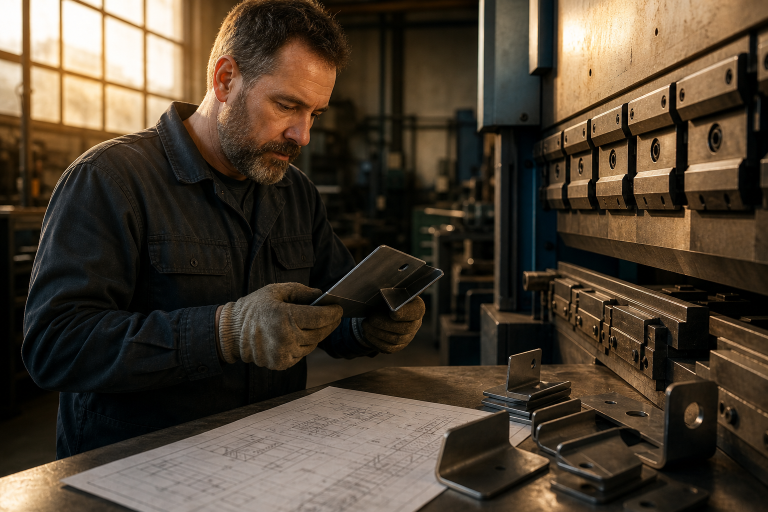
Forming turns a flat blank into a three-dimensional component. Bend radius, bend allowance, grain direction, and springback should be considered before production begins. Small drawing changes, such as moving a hole farther from a bend line or adding proper corner relief, can improve consistency and reduce distortion.
Machining
Machining is often well suited to parts with precise datums, tight features, pockets, threads, and complex geometry. It can be an excellent choice for functional prototypes and lower-volume production, although programming, workholding, setup time, and material removal can increase cost as part size or quantity grows.
Welding and joining
Welding and mechanical joining are useful for frames, enclosures, supports, and multi-part assemblies. Joint access, weld sequence, distortion control, appearance, and inspection should be addressed during design. A strong weld on paper may be difficult to produce repeatedly if a torch, fixture, or inspection tool cannot reach the joint.
Additive manufacturing
Additive manufacturing can support rapid design changes, complex shapes, custom fixtures, and lower-volume applications without traditional tooling. The NIST overview of additive manufacturing explains its value for rapid iteration and customized production. Still, printed metal parts may need machining, heat treatment, finishing, or additional validation to meet final performance requirements.
Match the process to quantity and cost
Quantity changes the cost equation. For one to a few parts, speed and low setup expense usually matter most. For small batches, repeatable programming and limited fixture costs become more important. Medium runs require attention to cycle time, labor, inspection, finishing, and material utilization. At larger volumes, dedicated tooling, automation, standardized setups, and stable process control may justify greater upfront investment.
Compare total project cost, not only unit price. A low per-part price may hide tooling charges, long setup time, secondary operations, packaging needs, or a higher risk of rework.
Account for tolerances and surface finish
A tolerance defines how much a dimension may vary while still allowing the part to perform correctly. Not every feature needs the same level of precision. Identify the dimensions that control fit, movement, sealing, alignment, or safety, then avoid applying tight tolerances to cosmetic or noncritical features. Unnecessarily narrow tolerances can increase inspection time, scrap, machining, and overall cost.
Finish requirements matter too. Paint, powder coating, plating, polishing, deburring, and corrosion protection can affect dimensions, appearance, durability, and assembly. Every tight requirement should have a functional reason.
Plan the move from prototype to production
A prototype is not automatically a production plan. Some prototypes test form and fit, while others test strength, manufacturability, or real-world customer use. A practical path is to build a proof of concept, test key dimensions and function, refine material and finish requirements, create a production-intent sample, run a pilot batch, and update drawings before release.
Manufacturing.gov’s rapid prototyping guidance also notes that additive methods are now used for more than prototype models, including certain final parts and assemblies. The important question is whether the selected process supports the required performance and future volume.
Use design for manufacturing reviews
A design for manufacturing review connects the drawing to the production floor. Review material availability, thickness, hole spacing, bend radii, corner relief, weld access, machining access, fixture needs, coating masks, inspection points, packaging, and assembly steps. This is not a criticism of the design. It is a practical way to identify avoidable cost, quality, and lead-time risks before they become production problems.
Questions to ask before requesting a quote
- Which material and thickness are most appropriate and readily available?
- Which dimensions require inspection and documentation?
- Are the stated tolerances realistic for the selected process?
- Are programming, tooling, fixtures, setup, and finishing included?
- Can the process support future increases in volume?
- How will the first part be approved and design changes controlled?
Common process selection mistakes
Frequent mistakes include choosing solely by unit price, using prototype materials that conceal production risks, specifying tight tolerances everywhere, delaying finish decisions, and failing to test parts under actual operating conditions. For example, an enclosure may fit perfectly in a workshop but create problems in production because bend sequencing, fastener access, or coating thickness was not considered.
A simple process selection checklist
- Define the part’s job and operating environment.
- Confirm material, quantity, critical dimensions, and finish requirements.
- Compare setup costs, lead times, repeatability, and future capacity.
- Review the design for manufacturability before ordering.
- Approve a production-intent sample and document the inspection plan.
Final thoughts
Choosing a fabrication process is a design, cost, and production decision at the same time. The strongest choice is rarely just the newest or least expensive method. It is the process that delivers reliable parts with the right balance of performance, quality, speed, and total cost.