

Need pad printers for sale? A manufacturer’s guide to Diversified Printing
Sponsored content. This article was supplied by a third party and Business Money has been paid to publish it.
Key takeaways
- Diversified Printing supports pad printing applications involving difficult shapes and precise graphics.
- Buyers should compare equipment by image size, required cycle rate, accuracy, part geometry, and production volume.
- Print quality depends on more than the machine. Pads, plates, fixtures, ink, surface preparation, and curing also matter.
- Detailed part and production information help identify the most suitable pad printing configuration.
Manufacturers seeking dependable marking on curved, recessed, textured, or irregular components need more than a basic printing machine. Diversified Printing helps buyers evaluate pad printers for sale according to part geometry, artwork size, color count, production targets, ink performance, and automation requirements.
The best system is the one that supports consistent image placement and durable adhesion while fitting the realities of the production floor. From straightforward one-color identification marks to integrated multi-station processes, Diversified Printing can help align the printer, pad, plate, tooling, ink, and curing approach with the application.
Why do complex parts create printing problems?
Many products do not offer a large, flat surface for decoration. Molded housings, control panels, drinkware, medical components, sporting goods, and safety products may include curves, ribs, recesses, angles, or textured areas that complicate conventional printing. As an indirect process, pad printing transfers a two-dimensional image to a three-dimensional object using a flexible silicone pad, making it well-suited to challenging surfaces.
However, the process still must be engineered properly. Common issues include ink that smears or lifts, graphics that shift between cycles, difficult job changeovers, poor access to recessed locations, and production speeds that do not match demand. A carefully selected pad, fixture, plate, ink, and print sequence addresses these variables together.
Which pad printing systems does Diversified Printing provide?
Diversified Printing offers pad printing options for different production needs rather than treating every part as the same application. The appropriate system depends on the largest image area, the number of colors, the surface being printed, the required output, and whether operators will load parts manually or the equipment will be integrated into a production line.
Common system categories
- Single-color printers: A practical fit for logos, serial markings, symbols, control legends, and other focused graphics.
- Multi-color printers: Designed for products requiring coordinated placement of several colors without separate manual printing stages.
- Integration printers: Suitable for manufacturers that need pad printing to work alongside assembly, molding, inspection, or packaging equipment.
- Modular systems: Useful where flexibility, application-specific configuration, or future expansion is important.
How can buyers compare pad printers?
A productive buying discussion starts with measurable application requirements. Instead of selecting equipment solely by purchase price, compare potential systems based on factors that affect throughput, quality, and long-term operating consistency.
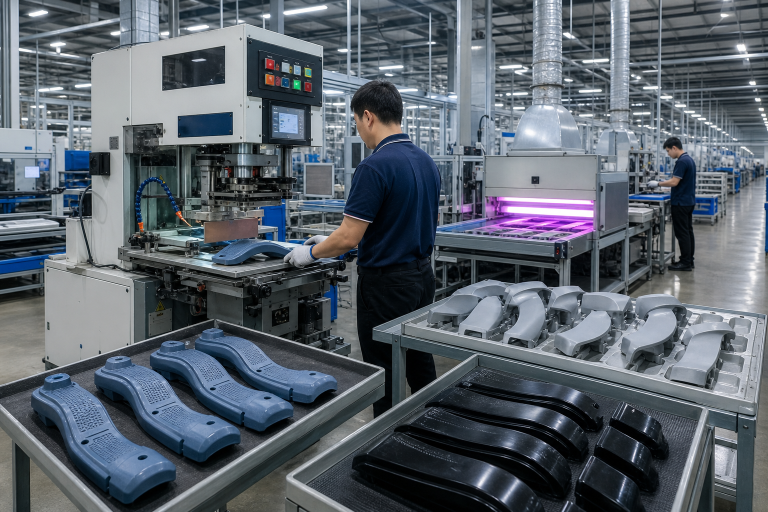
- Image size: Identify the maximum dimensions of the artwork. The plate, ink cup, and pad must support the image effectively.
- Cycle speed: Determine how many parts must be printed per hour, shift, or day, accounting for realistic loading and changeover times.
- Placement accuracy: Define the allowable tolerance, especially for functional symbols, tight registration, or multi-color artwork.
- Part geometry: Provide details on curves, recesses, texture, material, and available print area.
- Production scale: Clarify whether the work is occasional, recurring, or continuous high-volume production.
For example, integration-oriented equipment can be evaluated by maximum image size, cycle capability, pad compression, footprint, power requirements, and stated positioning accuracy. Those specifications become more useful when considered alongside actual part handling, operator involvement, and downstream process needs.
How does diversified printing support precision and repeatability?
Machine capability is only one part of a successful print process. Repeatable results require coordinated consumables and stable process conditions. Ink viscosity affects how ink behaves during the cycle, while plate quality controls the image pickup. Pad shape, hardness, material, and mounting influence both release and placement on the part.
Tooling is equally important because even a well-configured printer cannot compensate for a part that moves or sits inconsistently in the fixture. Mechanical, static, rotating, and vacuum fixture approaches can be matched to the product. Application testing before production helps confirm expectations for image quality, adhesion, registration, and durability.
Which industries use pad printing?
Diversified Printing’s pad printing systems can support a broad range of product-marking challenges. Medical products may require fine identification graphics or control marks. Automotive components often require durable markings on shaped, molded parts. Drinkware and promotional items benefit from printing on curved surfaces, while sporting goods may require graphics on golf balls or other non-flat products.
Additional applications include hard hats and safety equipment, consumer tools, electronic controls, appliance components, cosmetic packaging, and branded giveaway items. The common requirement is not the industry itself. It is necessary to place a clean, repeatable image on a surface that is difficult to print with simpler methods.
What equipment and supplies are needed for a complete process?
A complete pad printing solution includes more than a printer. Diversified Printing can support the related components that influence output:
- Printing pads selected by shape, hardness, material, and mounting method.
- Printing plates are chosen for artwork detail, expected production life, and job requirements.
- Tooling and fixtures that hold the part consistently during every cycle.
- Inks matched to the substrate, color, durability, and curing requirements.
- Pre-treatment and curing equipment for challenging materials or demanding adhesion goals.
How are ink adhesion and compliance considered?
A graphic that looks good immediately after printing may still fail if the ink, substrate, pre-treatment, and cure are not compatible. Ink selection should account for plastics, metals, glass, rubber, coatings, and other material variables, as well as resistance to abrasion, chemicals, heat, moisture, and dishwashing.
Depending on the application, a process may use solvent-based, UV-curable, epoxy, or silicone ink systems, with air, hot-air, infrared, or UV curing. Manufacturers should also review relevant workplace, ventilation, VOC, and environmental requirements. The EPA notes that printing operations vary with the substrate, run length, speed, required image quality, and end product, underscoring the value of application-specific planning.
When should a manufacturer consider integration or automation?
Integration becomes more attractive when production requires stable high-cycle output, reduced variation in part loading, multiple print stations, or connection to assembly and inspection equipment. It can also be appropriate when traceability, repeatable settings, and consistent handling are critical.
Automated or integrated systems should be evaluated as a complete workflow, not simply as a faster printer. Part presentation, fixture design, loading, curing, inspection, rejection handling, and maintenance access all affect the final result.
What should be included in a pad printer for sale request?
A detailed request gives Diversified Printing the information needed to recommend a practical solution. Include product photos, drawings, or CAD files; part dimensions; print location; artwork size; color count; substrate; expected production volume; and required cycles per hour.
Also specify durability expectations, available floor space, power and compressed-air availability, existing equipment, and whether the process should be manual, semi-automatic, integrated, or fully automated. If medical, toy-safety, RoHS, REACH, BPA-related, or other specifications apply, include them early in the evaluation.
Frequently asked questions
What does Diversified Printing provide?
Diversified Printing provides pad printing equipment, pads, plates, inks, tooling, pre-treatment options, curing support, and solutions for integration or automation projects.
Can pad printers mark curved parts?
Yes. With the proper pad, fixture, ink, and settings, pad printing can transfer graphics onto many curved, recessed, textured, concave, convex, and irregular surfaces.
How do I choose the right printer for a small production run?
Start with the part shape, artwork size, number of colors, material, setup frequency, and anticipated volume. An application review is more dependable than choosing based solely on machine price.
Why is custom tooling important?
Custom tooling keeps each part in a repeatable position. That stability helps maintain image placement, reduces variation, and supports efficient production.